
With the changes to SERP layouts and prominence of AI results, business owners need to understand the implications for website traffic. Learn more…
AI is impacting all areas of business management, something we are constantly reminded of every time we carry out a search on Google. Google is constantly changing how it uses AI in search results, evaluating new options to see what works best. In determining what works best, it is trying to balance the sometimes conflicting needs of the user, content creators and their desire to generate advertising revenue.
For business owners who are trying to maximise their online exposure and website traffic, what works best for Google does not necessarily work best for them. The use of AI in search engines has had a big impact on SEO strategies and it is important for business owners to keep up to date with the changes in search engines and how it impacts their marketing plans.
Understanding SERP layouts
The search engine results page (SERP) layout is constantly changing, so the following description only describes the current state of play. It may be out of date tomorrow!
Using “termite inspection” as a search term, the initial search results show an advert at the top of the page, followed by an AI overview, followed by local pack results (inside which there is a paid position), followed by ‘People also ask’ questions and finally (off the bottom of the screen), are the organic search results (Figure 1).
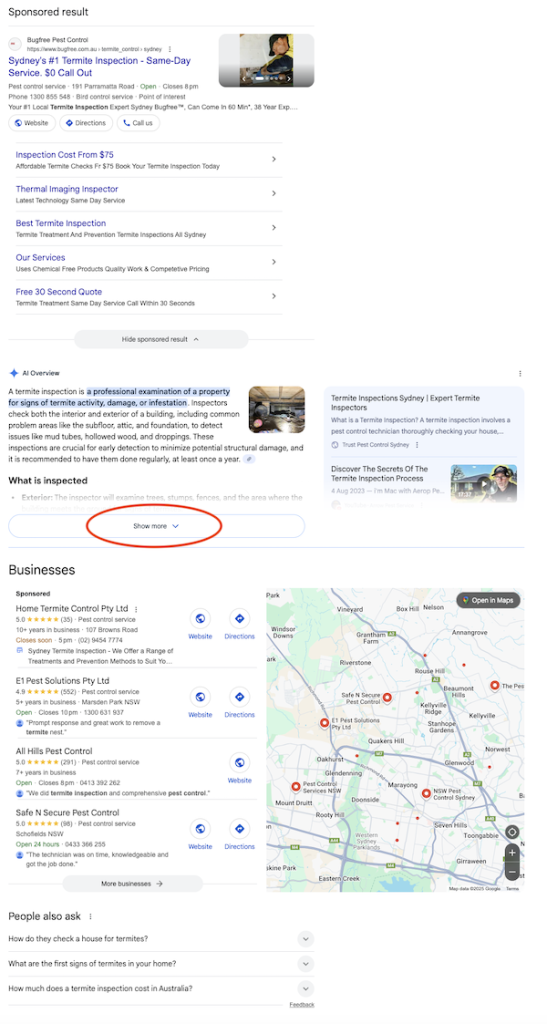
If you click ‘Show more’ under the AI Overview, it expands the AI result (Figure 2). Note that specific links are shown to the right of the result, which can also be expanded by clicking on the ‘Show more’ button. Clicking on the link symbol next to bullet points in the AI Overview will also display relevant links in the right-hand panel.
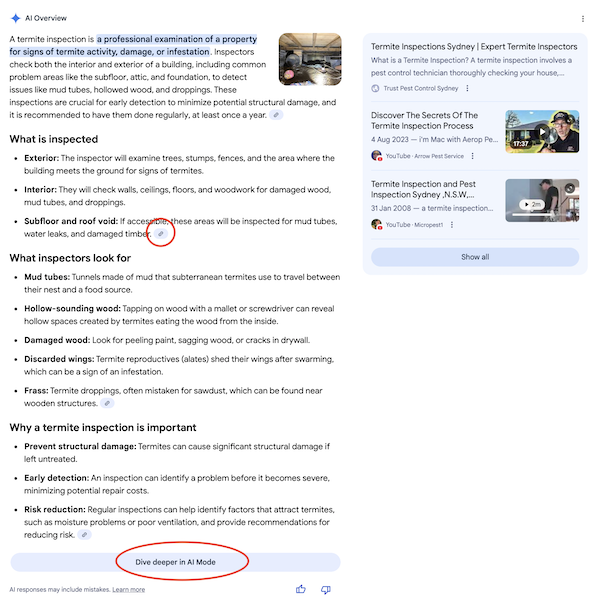
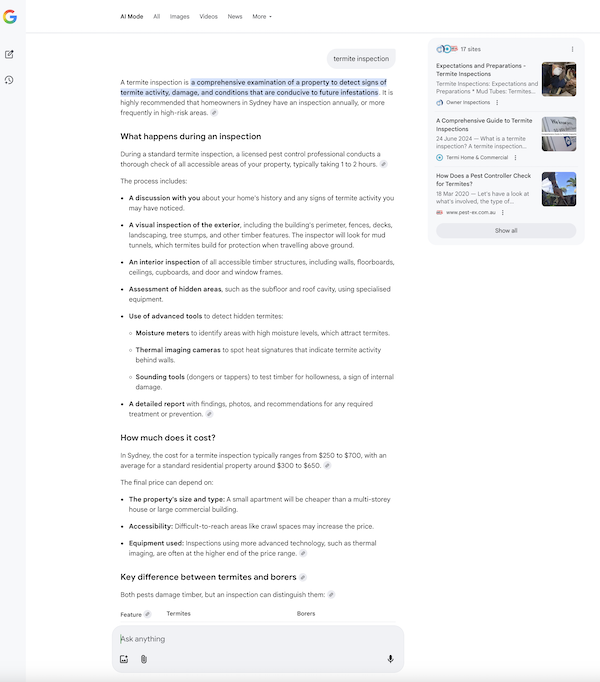
At the bottom of the AI Overview, there is an additional button – ‘Dive deeper in AI mode’. Clicking on this takes the user into Google’s Gemini AI to carry out further AI searches (Figure 3). Relevant links are still shown in the right-hand panel.
Commercial v informational searches
It is important to understand that there are significant differences in the layout of SERPs for commercial and informational searches. For commercial searches (e.g. “termite inspection Sydney”), adverts are very visible with local pack results underneath and AI results less visible. Google knows that the user is likely looking for a commercial service, so it’s a big opportunity to get advertising revenue. As a result, adverts appear at the top. Users are probably looking for a local service, so the local pack results are next. Organic results are displayed ‘below the fold’, which means you need to scroll to see them.
For informational searches (e.g. “What are termites?”), there is little advertising money to be made. As a result, there are no adverts to be seen, with AI results dominating. But again, organic results are displayed ‘below the fold’.
The impact of AI on organic results
The new SERP layout has seen a significant drop in clicks on organic search results. This drop in clicks is partially driven by their location (below the fold), but is mainly driven by the appearance of AI results, especially for informational type searches. After all, if the answers you seek are displayed on screen in the AI results, why click through to a website? For commercial services, users are still likely to want to click through to the website to get more information, especially contact details.
Although Google claims that websites get more clicks from AI Overviews than from traditional web listings, website owner data suggests otherwise. The drop in clicks through to websites for informational searches has been significant – up to 75% in some cases. Google knows it is important to encourage content creators to generate original content, yet the current SERP layout does not reward content creators, despite what Google says.
Previously, SEO for high organic rankings was essential for success. But now, although it is still important, it is necessary to have a more holistic approach to ensure high rankings in paid ad positions, local pack results and, despite the low click through rate, in AI results.
How to rank in AI results
Some of the key elements to rank well in AI results are the same as those required to rank well in organic search results:
- Develop E-A-T-T (Experience, Expertise, Authority and Trustworthiness) for your website
- Work on generating detailed, in-depth, high-quality content
- Ensure each page has a clear structure, with good headings and necessary schema
However, the big difference is that whereas previously the instruction was always to write like a human, it’s now necessary to also think like a machine (AI). This means creating content with a structure that meets the requirement of AI. In particular, this means:
- SEO activities should target questions, not just keywords
- Provide concise answers first, before providing an in-depth explanation
- Consider your FAQ section, with schema
The use of AI in search results is changing daily – Google is experimenting all the time. As a result, website owners also need to respond and evaluate. The time of a set and forget website is long gone. To remain relevant and achieve exposure in all parts for the SERP, it is necessary to spend more time (and money) on SEO and content management.