
The world of AI is moving fast! In an attempt to keep pest managers up to date with recent developments in AI technology, Dr Phil Ridley from Bug Doctor Media provides the latest news in this sector.
The world of AI is moving fast! In an attempt to keep pest managers up to date with recent developments in AI technology, Dr Phil Ridley from Bug Doctor Media will provide the latest news in these regular articles.
Many small businesses have already dabbled, some more than others, in using AI for content creation for their websites. Whilst it can be a great starting point for generating ideas and getting articles started, it’s important to remember firstly, that the content it generates is not always correct and secondly, that AI-generated content is not original, in that it re-purposes content already on the web. And Google doesn’t like unoriginal content.
Google has repeatedly emphasised that in order to rank well in search results, content creators need to create original material that meet the E-E-A-T quality guidelines. For many years it was only E-A-T – Expertise, Authority, Trustworthiness – but more recently Google has added another ‘E’ – Experience. If the content is written by a person demonstrating these attributes and it appears on a website that consistently delivers E-E-A-T, then the content will be viewed favourably in the eyes of Google. Obviously, unfiltered AI-generated content is unoriginal and certainly doesn’t meet Google’s E-E-A-T guidelines.
Previously Google ‘rewarded’ the quality content with high rankings, yet some spammy content still ranked well. With the arrival of AI-generated content, Google is increasing its efforts to actively penalise spammy, unoriginal (AI) content.
Google started a core algorithm update at the start of March 2024 to address spammy content. Google rarely specifies exactly what a particular update is focusing on, so for Google to specifically state the update was targeting spammy content made SEO experts pay attention. Google stated it was targeting a 40% reduction in spammy content in search results. The rollout was completed by the end of April with Google stating that the update had delivered a 45% reduction in low-quality, unoriginal content appearing in search results. In fact, Google has actually de-indexed whole websites, which has obviously had a big impact on the businesses concerned.
So, think very carefully how you use AI for content creation. Always try to create original content and follow the E-E-A-T guidelines.
Of course, Google itself is using AI to improve its offerings to users. Google announced in May 2023 that it would be using AI to improve search results, as always, with the user in mind. The result is SGE (Search Generative Experience), where Google will present an AI-generated panel at the top of the results page. The panel will actually present answers to the search question, rather than links to web pages, along with other related questions to consider and an additional box to enter follow-up questions. Currently, this technology is still in the experimental stage (not currently in Australia or New Zealand) and is being evaluated in a limited number of locations. But it will be coming!
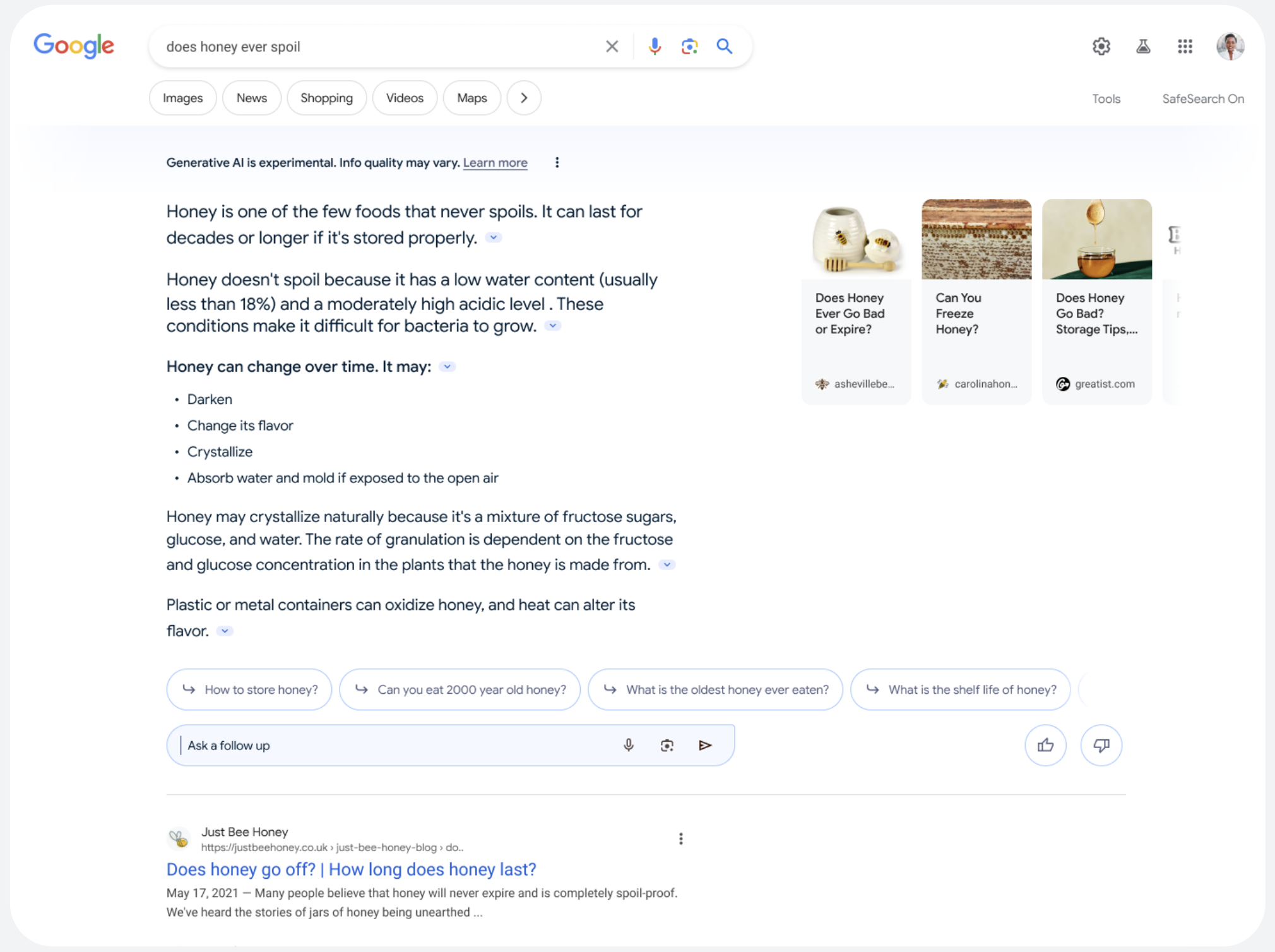
If its current format is fully rolled out, there are a number of potential impacts. Firstly, it’s important to point out that SGE will only likely apply to informational searches, targeting long-tail keywords (questions). One reason for this is that as the SGE results panel is at the top of the page, Google certainly won’t want to lose out on paid advertising revenue. If SGE starts to appear for more commercial search terms it is likely Google will introduce a paid advertising section to the SGE. However, when SGE is rolled out globally, the big impact will likely be on the organic search results.
Firstly, featured snippets – the organic search results with a lot of additional information that currently appears at the top of the page and gets increased clicks – will disappear. Secondly, the fact that the SGE results panel will actually show potential answers to the question will likely result in fewer clicks to websites, even those that might be displayed in the SGE results panel. In conclusion, websites currently performing well in organic rankings may receive fewer clicks. To counteract this, it may be necessary to increase paid advertising.
To minimise the impact, it will obviously help to get your content selected as the best answer by the SGE and get a link in the search panel. To do this, it will be important to follow E-E-A-T guidelines, but it will be necessary to consider the relevant long-tail search terms and build FAQs on your website around these questions. As Google also wants to present the latest information, the use of a recent publishing date and regularly updating content will be important.