The Sentricon system celebrates 30 years of protecting homes against termite attack.
As pest managers, we rarely think about the technology behind the products we use. We simply buy the product, use the product and expect it to work. But there is generally a lot of know-how behind the products we use, none more so than in termite baits. The arrival of termite baits onto the market back in the 1990s was genuinely revolutionary. Leading the way was Sentricon. Now celebrating 30 years on the market, it’s worth having a closer look at the innovations behind Sentricon, and its journey through research and product development to commercial success.
Necessity is the mother of invention. For termite baits, the need was to find an alternative to chemical soil treatments for termite management. At the time, organochlorines and organophosphates were the primary chemicals used in soil treatments, and their negative environmental and toxicological profiles meant their days were numbered. As is often the case, it is sometimes a combination of ideas that leads to a significant innovation. In the case of Sentricon there were three key discoveries that lead to success.
It’s always important to “know your enemy”. This is why fundamental research into pest behaviour and biology is essential. Back in the mid 1980s, Dr Nan-Yao Su published a series of papers on termite foraging behaviour. Three key findings of the research confirmed that: firstly, termites would recruit fellow workers to a favourable food source; secondly, that the food would be transported directly back to the nest; and thirdly, that termites would exhibit trophallaxis to pass food around the colony. Tapping into these natural behaviours, the development of a bait using a suitable active and attractive bait matrix would have potential in termite management.
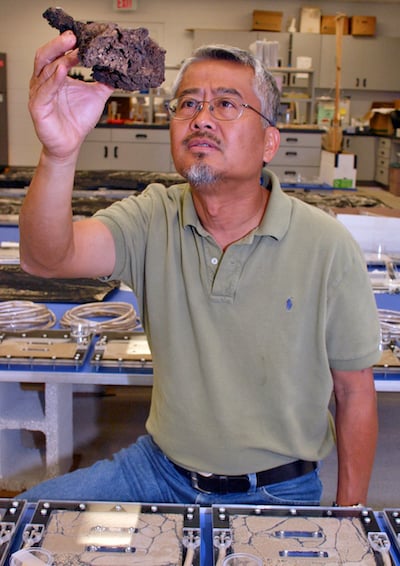
Active selection would be critical to success. It would need to be both non-repellent and slow acting. Knowing the mode of action of insect growth regulators would be slow (as they would kill individual termites during moulting), they appeared an ideal candidate group of chemicals. Hexaflumuron (the active used in Sentricon) was actually discovered in 1981, but it wasn’t until 1989 that trials had been carried out with termites to determine that it had great potential for use in termite baits. At the same time Dow Agrisciences (now Corteva Agrisciences) and Dr Su signed a joint venture agreement to develop the industry’s first commercial bait delivery system.
Proof of concept was a good start, but a commercial termite bait needed an attractive bait matrix and system for applying the product. Over the next three years product development and extensive testing allowed the creation of the prototype Sentricon baiting system. Tamper-proof, plastic in-ground monitoring stations would be installed around the property to be protected. Timber billets would be used to attract termites into the monitoring stations. Once active feeding was occurring, an attractive cellulose bait matrix containing hexaflumuron was added.
The performance of this termite baiting system would be a game-changer. Not only would the system eliminate active termites from the building, but it would actually eliminate the colony attacking the property, without needing to find the nest. All this could be achieved without the need to apply a large amount of chemical into the environment. The Recruit termite bait (the bait used in Sentricon) became the first product registered under the US EPA Reduce Risk Pesticide Initiative and by 1995 the Sentricon termite system was launched in the US.
Parallel testing in Australia demonstrated the system was equally effective against Australian termite species and Sentricon was launched in Australia in 1997.
From the initial idea, it took well over ten years for this revolutionary product to be developed into a commercial product. But the research didn’t stop there, with ongoing research into termite behaviour and product performance, bait matrix improvements led to the launch of the Sentricon II Advance Control System in 2004.
The research continued, with work on the next significant innovation already underway. Sentricon AlwaysActive was launched in 2010 in the US and in 2015 in Australia. This robust and palatable bait matrix was not an adaptation of the existing bait matrix, but a new bait matrix re-designed from the ground up. Designed from the get-go to be left in place for many years, to be ready whenever termites move into an area, the AlwaysActive termiticide rods are not only highly palatable and durable, but retain their palatability and integrity for many years, even in flooded ground.
With Sentricon AlwaysActive celebrating its ten-year anniversary in Australia this year, the brand continues to deliver on its promises, helping pest managers in turn deliver the best possible termite management services for their customers.