
Paul Commerford, Founder of Greenzone, explains why the Altis system is different to other reticulation systems on the market.
Pre-construction termite management has always been the unglamorous end of the pest control business. The work happens before the walls go up, before the client moves in, and long before anyone will know whether the treatment did its job. But get it wrong, and the consequences are severe – for the homeowner, for the builder, and for the pest manager whose name is on the paperwork.
That’s why the shift happening right now in the pre-construction space deserves attention. The Altis Pro Reticulation System by Greenzone, built around precision emitter technology and a choice of bifenthrin or fipronil as the active constituent, is changing the way pest managers think about soil and perimeter treatment on new builds, and the results on the ground are hard to argue with.
The old problem with pre-construction
For years, pre-construction termite treatment has followed a fairly predictable pattern: soil treatment under the slab, perimeter application, certificate issued, job done. This was certainly my experience when I was working as a building and pest inspection professional.
The challenge has always been consistency. Soil types vary, construction timelines slip, and application conditions are rarely ideal. A treatment that performs well in sandy coastal soil may behave very differently in reactive clay inland.
Pest managers doing pre-construction work have had to make constant judgement calls, and those calls have consequences that play out years later when a homeowner discovers termite damage and starts looking for someone to blame.
What the Altis Pro by Greenzone does differently
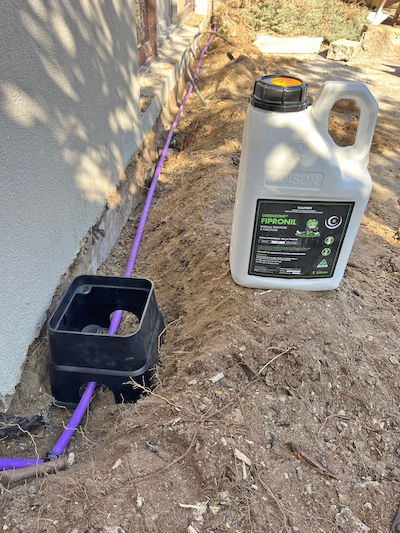
The Altis Pro Reticulation System addresses this directly. At the heart of the system is precision emitter technology. The emitters are the key, controlling the flow of chemical to deliver the correct rate of 5 litres per metre or more, consistently and reliably across the treated zone (main picture, above). This is not just about convenience. It is about accuracy.
Because the emitters regulate delivery so precisely, pest managers can pinpoint the right amount of bifenthrin or fipronil for the specific conditions of each site, minimising chemical use, reducing application risk, and giving them a defensible, documented treatment they can stand behind.
This matters more than it might initially seem. Using the right active at the right rate is not just good practice, it is how pest managers protect themselves from liability. Under-dosing creates gaps in protection. Overdosing creates compliance issues. The Altis Pro emitter system takes that guesswork off the table entirely.
In practical terms, this means pest managers are spending less time second-guessing their application and can feel confident that the treatment has been laid correctly and will perform.
There are three specific real-world scenarios where we’ve seen Altis Pro making a difference.
Scenario 1: Treating areas that can’t be accessed after construction
The first scenario is treating areas that can’t be accessed after construction. One of the most critical and often under-appreciated challenges in pre-construction termite management is treating areas that will become permanently inaccessible once construction is complete. Concrete poured under a slab, areas destined to be covered by paving, landscaping pavers, or concrete paths, are zones a pest manager simply cannot get back to in 12 months to reassess or re-treat.
This is precisely where AS 3660 becomes relevant. The standard recognises that where ongoing access for inspection and re-treatment is not possible, the initial treatment must be robust enough to account for that limitation. Altis Pro by Greenzone is designed with this in mind, with its emitter technology delivering a precise, consistent chemical barrier suited to these inaccessible zones, giving pest managers confidence that the treatment will continue to perform in areas they will never be able to revisit. For pest managers, this is not just a product decision, it is a liability decision.
Scenario 2: Difficult or variable soils
The second scenario is in areas with reactive clay soils or high moisture, where chemical barriers have historically been harder to apply with confidence. The Altis Pro emitter system is designed to account for these variables, maintaining a consistent delivery rate regardless of conditions, giving pest managers a more reliable outcome even when the site is not playing ball. Unlike conventional perforated-pipe systems where output drops as soil back-pressure increases, the Altis Pro emitter maintains its metered delivery rate regardless of soil resistance. In reactive clay where absorption is slower, the chemical is still being delivered at the correct rate – the emitter compensates for what the soil is doing.
Scenario 3: Volume builders and project home sites
The third scenario is when working with volume builders and project home sites. For pest managers working with volume builders across multiple estates, consistency is everything. The Altis Pro provides a standardised approach that can be replicated across sites, reducing variability in application and making quality control far more manageable at scale.
What this means for pest management businesses
Pre-construction termite work carries long-tail liability. A treatment certificate issued today is a commitment that extends for years, and pest managers need to be confident in the products and systems they are using.
But here is the part that often gets overlooked: every pre-construction treatment completed with the Altis Pro system creates a relationship, not just a job. The homeowner who moves into that property is now on your books. They will need annual inspections. They will call you when they see something concerning. They will refer you to their neighbours. In a service business, a recurring, trusting customer is gold, and the Altis Pro system is a direct pathway to building that kind of client base.
For pest managers thinking about the long-term value and eventual sale of their business, recurring clients are not just good for cashflow; they are what makes a business worth buying. A client database built on quality pre-construction work, done right with the right system, is a genuine business asset.
The shift toward precision application systems like the Altis Pro reflects a maturing of the pre-construction market. Pest managers are no longer just buying a chemical, they are buying into a system that supports correct application, builds lasting client relationships, and ultimately positions their business for the future.
For those doing significant volume in the pre-construction space, Altis Pro is worth a serious look. The conversation happening around Greenzone right now is not just about our products, but about how we are helping smart pest managers build better businesses.
The maths that makes it defensible
One of the most practical advantages of the Altis Pro Reticulation System is that a pest manager can calculate exactly what is happening inside the pipe – there is no estimation involved.
- The emitter ribbon runs emitters at 175 mm centres, which gives 5.7 emitters per linear metre
- Each emitter is rated at 3.6 L per hour at 96.5 kPa (14 psi).
The maths from there is straightforward:
- 3.6 L/hr × 5.7 emitters = 20.5 L per hour, per linear metre of system
AS 3660 requires a minimum of 5 L per linear metre. At 20.5 L/hr output per metre, a correctly pumped system delivers that in approximately 14-15 minutes of charge time and that rate holds consistently across the full length of the run.
What this means on the job: you measure your linear metres, multiply by 5 to get your target volume, set a timer, and you’re done. You don’t need to estimate. You don’t need to second-guess whether the far end of the pipe got what it needed. The emitter does that work for you, and you walk away with a treatment you can document and stand behind.
This is particularly valuable in reactive clay soils, where a conventional perforated-pipe system loses output as soil back-pressure builds. The Altis Pro emitter maintains its metered rate regardless of what the surrounding soil is doing. The chemical is delivered at the right rate even when the soil absorbs it slowly. The barrier is laid correctly the first time, in conditions that would compromise a lesser system.
For pest managers who need to demonstrate compliance, especially on sites with inaccessible zones that can never be retreated, that calculable, consistent delivery is not just a convenience – it is your liability protection.
Paul Commerford, Founder, Greenzone