Dr Nicholas Poulos, postdoctoral termite researcher at the University of California, Riverside, shares new discoveries into determining the age of drywood termite frass.
Drywood termite faecal pellets have long been a point of interest for pest management professionals and homeowners. Aside from seeing the termites themselves, faecal pellets are a sure sign of infestation. But are the faecal pellets freshly produced, indicating an active infestation, or are they merely old faecal pellets from past termites that have been successfully treated?
With significant costs associated with drywood termite treatments, it is clearly desirable to know if an infestation is active or not, to avoid unnecessary treatments. The ability to determine the relative age of faecal pellets may provide a valuable tool for informing management decisions. Sampling faecal pellets offers a non-invasive and non-destructive monitoring tool and here we present a new way of answering the common question, “How old are these faecal pellets?”
Chemical compounds to age faecal pellets
Previous investigations have used the change of hydrocarbons and other chemical compounds over time to age faecal pellets (Haverty et al. 2005, Lewis et al. 2010, Haigh et al. 2024). These approaches primarily used gas chromatography-mass spectrometry (GC-MS), a method of identifying what substances make up a test sample. While GC-MS is a powerful technique, it requires expensive equipment, lab space, and training to operate and interpret results, resulting in a time-consuming process. These factors add up to a relatively high ‘cost of admission’, representing a challenge to the industry-wide adoption of GC-MS for faecal pellet assessment.
Opportunity remains to develop a cost-effective method capable of distinguishing freshly produced pellets from aged in the field, circumventing the need for expensive equipment and a lab to house it in. We found bacteria to be suitable for this purpose due to their use in other fields.
Microbial biosensors
Microbial biosensors, capable of detecting bacteria of interest in tested samples, exhibit the technology necessary for this vision. In the health sector, the rapid onsite detection of specific pathogens is of great value with ongoing development and refinement. Traditionally, bacteria identification has been reliant on lab-intensive methods such as culture-based assays, polymerase chain reaction (PCR) and GC-MS. New biosensor methods explore the use of antigens, antibodies, aptamers, and proteins to detect specific bacteria. These biomolecules can be referred to as biomarkers, distinct signals that allow for the identification of bacteria. In other contexts, biomarkers can identify the presence of certain disease-causing pathogens, while here we proposed bacteria as an approach to reveal the relative age of faecal pellets.
Termite gut microbiota
Given the fundamental symbiotic relationship between microbiota and termite for the digestion of wood (Brune and Dietrich 2015), targeting bacteria as a biomarker was thought of as a reasonable endeavour. Termites harbour complex and diverse microbial communities in their digestive system comprised of prokaryotes (Archaea and Bacteria), eukaryotic protists (lost in Termitidae, higher termites), and fungi. The bulk of these microbes are found inside the hindgut, the largest structure in the termite digestive system. Prokaryotes such as bacteria perform essential functions including acetogenesis, fermentation, methanogenesis, and nitrogen fixation.
These microbial gut communities persist across generations of termites through the exchange of hindgut fluids via proctodeal trophallaxis. We proposed that since bacteria-containing hindgut fluids and pellets are direct products of the termite hindgut, it is probable that some bacteria from the hindgut may be present in faecal pellets. Furthermore, the presence or absence of certain bacterial taxa at certain timepoints may allow us to categorise faecal pellets according to their relative age.
Drywood termite faecal pellet sampling
We investigated the bacteria present in faecal pellets of the western drywood termite, Incisitermes minor at four different time points: fresh (one week old or less), three months, six months, and one year. Faecal pellets were collected from termites kept on either wood from the logs they were collected from or commercial Douglas-fir two-by-fours. Since Douglas-fir is a common building material in I. minor’s native range in the United States, it was considered a reasonable choice for standardisation of the study. The fresh time point samples were collected one week after the introduction of termites to wood. After an additional week, termites were removed from the wood resulting in pellet stocks that would be aged for the duration of the study. These same pellet stocks were subsampled at three months, six months, and one year.
To identify what bacteria were present in the faecal pellet samples, 16S rRNA sequencing targeting the V3-V4 region was performed. This technique targets the 16S gene, present in all prokaryotes, which contains both conserved and hypervariable regions. The comparison of hypervariable regions of sampled specimens to reference profiles allows for the identification of known bacteria. The eventual goal of this study is the ability to distinguish freshly produced from aged pellets using bacteria as a biomarker without the use of time-consuming and costly techniques such as GC-MS or PCR. Ironically, in the search for a bacterial biomarker it was necessary to perform DNA sequencing on samples, which utilises PCR.
Bacterial DNA decreases in pellets as they age
We found differences in the amount of bacterial DNA present in drywood termite faecal pellets over time. The amount of bacterial DNA found in pellets started off relatively high in the first three months, dropping to lower levels afterwards (Figure 1). This drop in DNA offers an unanticipated approach to ageing pellets.
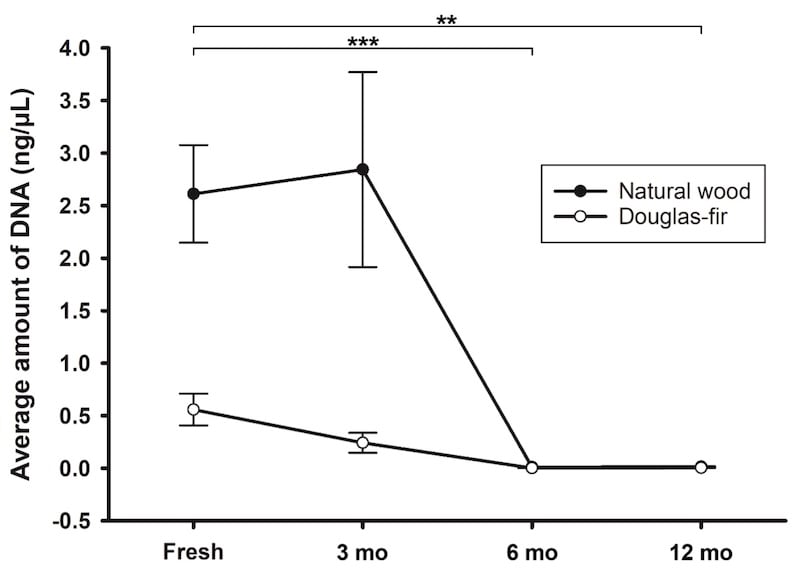
Fluorometers utilise specific wavelengths of light and measure the absorbance by a sample to detect the concentration of a molecule, in this case DNA. After initial purchase of device and materials, portable fluorometers offer a cost-effective approach for onsite DNA quantification of faecal pellets to reveal relative age. Further investigation is required to establish thresholds of bacterial DNA to accurately determine the relative age of faecal pellets.
Bacterial biomarkers to distinguish freshly produced from aged faecal pellets
The analysis of bacteria in faecal pellet samples revealed candidate biomarkers able to distinguish freshly produced from aged faecal pellets. Diversity metrics were calculated and compared based on the identity of bacteria found in faecal pellet samples according to wood type and age. These metrics factored in bacteria species richness (number of species), evenness (proportion of species), and how dissimilar overall species composition was among samples.
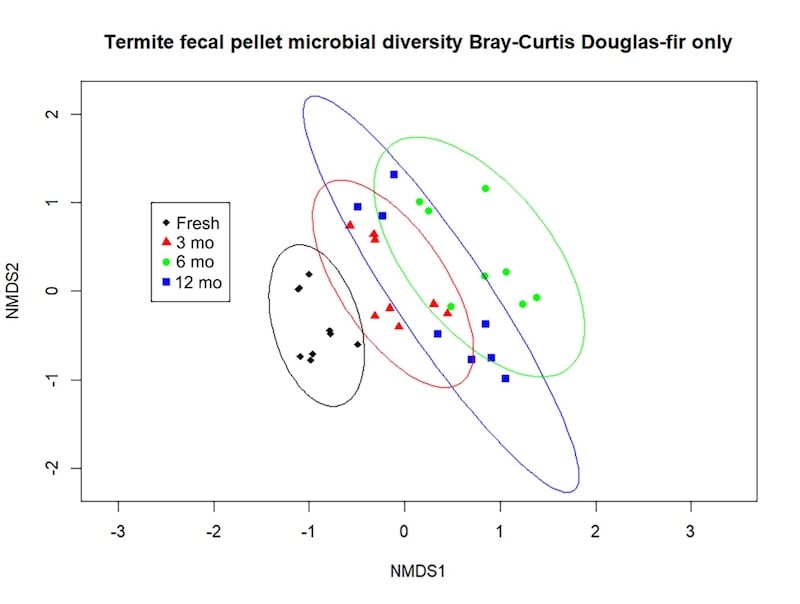
Pellets produced from Douglas-fir fed termites were the primary focus given their relevance to structural infestations. In Douglas-fir pellets, bacterial community structures from each sampled age were significantly different from each other (Figure 2). Further analysis explored what bacteria were driving these differences in community structure, revealing several candidates for use as biomarkers to distinguish freshly produced from aged faecal pellets.
The bacterial genus Treponema was found in all fresh Douglas-fir pellets but none of the six-month-old or one-year-old pellets. This dynamic offers a suitable system for pellet assessment where the presence of Treponema indicates pellets produced by an active infestation and the absence indicates the pellets are at least six months old.
In addition to serving as a basis for the characterisation of the microbiome of I. minor faecal pellets, the current findings suggest multiple candidate biomarkers which may be further investigated to develop a cost-effective method to distinguish freshly produced from aged faecal pellets. Simultaneously, it is important to investigate the possible impact that drywood termite control methods (i.e. fumigation, heat, residual insecticides, etc.) have on the microbial community of faecal pellets.
Written by Dr Nicholas Poulos, Postdoctoral Researcher, Department of Entomology, University of California, Riverside. Co-authored by Prof. Chow-Yang Lee and Prof. Dong-Hwan Choe, Department of Entomology, University of California, Riverside.
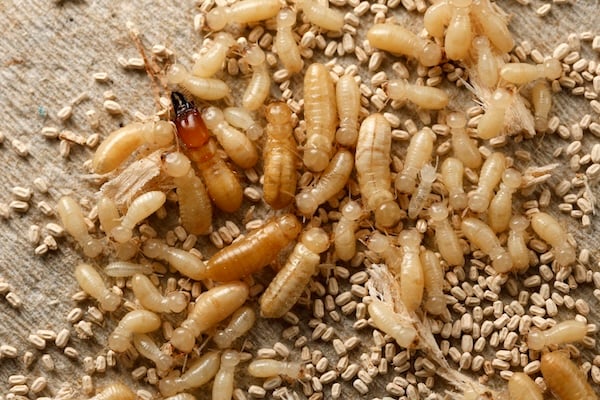
Main image: Drywood termite faecal pellets, a sign of infestation (photo credit: Dong-Hwan Choe)