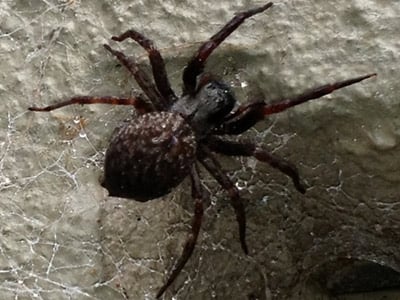
The black house spider is sometimes called the common black spider
Female: Body up to 18 mm (with 30 mm leg span)
The black house spider is dark brown / black carapace with a charcoal grey abdomen with white markings / hairs. The females are larger than the males. It’s legs are brown / black.
There is also the related brown or grey house spider, Badumna longinqua, which has a has a brown carapace (a similar coloured abdomen) and grey-brown banded legs.
Male: Body up to 10 mm
The legs appear longer in relation to the body than the female.
The black house spider produces messy, dense web, with an obvious a funnel-type centre (which is why homeowners can sometimes be mis-identified as a funnel-web spider). The web is generally kept clear of debris.
Mating:
Female black house spiders never leave their webs, so the males need to go looking for a mate. Once they have found a female they pluck the web to get her attention and make sure she is receptive to mating. Once together they tend to remain together for a couple of days, mating several times.
Eggs:
Black house spiders produce egg sacs which are secured within the funnel part of the web.
Baby black house spiders:
The baby redbacks or spiderlings hatch from their eggs within a couple of weeks and disperse. Sometime the spiderlings can remain around the perimeter of the web picking up smaller prey.
Life-span:
Black house spiders live for about 2 years.
Black house spiders and their close relative the grey house spider are found across the sub-tropical and temperate regions of Australia, from southeast Queensland down to Tasmania and across to Perth. They are occasionally found in warmer, tropical areas.
They are normally found on tree trunks, logs and under rocks although around buildings they are found:
Black house spiders will capture and feed on a wide range of flying and crawling insects. The will often build there webs near lights on buildings to capture flying insects that are attracted to the light at night.
Black house spiders are a favourite food of white-tail spiders.
Other than keeping rubbish and stored goods away from the perimeter of the property, the only way to eliminate a black house spider problem or prevent them building their webs is with a professional pest treatment.
Other types of spider.
Black house spiders are a timid spider and will retreat quickly into its web when disturbed. However, black house spider bites are moderately venomous and so if bitten its bite can be quite painful.
Bite Symptoms:
First aid:
As it can often get confused with other black spiders such as mouse spiders or funnel web spiders which are very dangerous, if you are not confident you have correctly identified the spider, you should treat the spider bite as per a funnel-web bite. ie. Immobilise the victim, apply a pressure bandage to the limb and immediately seek medical assistance.
Medical disclaimer: The information provided on this website is for educational purposes only and does not substitute for professional medical advice. If in doubt about identifying the spider or understanding the required first aid, seek medical attention immediately. ff the victim experiences a significant reaction to the bite (no matter which spider), seek medical help immediately.
In case of emergency call 000. If uncertain about what to do call the Poisons Information Line 13 11 26.
A professional black house spider treatment starts with a good inspection to ensure all webs and potential hiding places are identified.
Typically, a professional treatment will consist of a thorough perimeter spray, focusing on windows, doors, eaves and other entry points, which will target most of the common black house spider hiding spots.
Spraying webs and hiding places with a professional residual spray will achieve excellent results. Bifenthrin based products have an excellent reputation as a long lasting spider treatment.
Most professional pest manager will ofter a 6-month warranty on web-building spiders, such as the black house spider.
Webs can be removed 2-3 days after the treatment. Any webs should be brushed down and not washed away with water, as it will also wash away the insecticide, reducing the duration of protection.
Although black house spider bites are moderately venomous, they are not considered particularly dangerous as they are not an aggressive spider. They will generally retreat quickly, deeper into their web when disturbed, so bites are not particularly common. There is no anti-venom available and no specific medical treatment is required.
Are black house spiders dangerous for dogs?
There is no information to suggest black house spiders are specifically dangerous to dogs or other pets. If a dog is bitten, seek veterinary assistance.
Black house spiders are sometimes confused with funnel-web spiders, mainly due to their funnel-shaped web.
Black house spiders and funnel-web spiders can be distinguished using the following features: