An overview of all the key facts pest managers should know about the redback spider.
The redback spider, Latrodectus hasselti, is one of Australia’s infamous spiders. It is the most commonly reported spider bite, with over 2000 reported each year (although in reality there are probably a lot more), with around 15% of these cases requiring hospitalisation.1 With most of these bites reported to have occurred around the home, a pest control treatment or ‘spider spray’ is certainly a good idea to protect people and pets from potential redback bites. But what do you really know about this Australian icon?
Redback identification
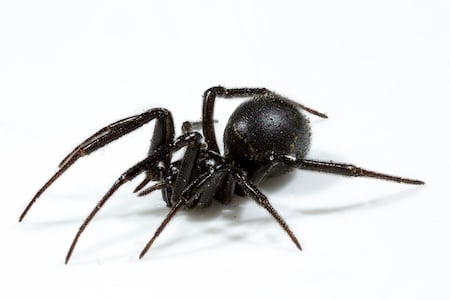
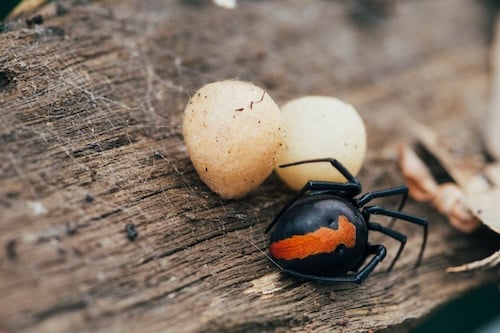
It may seem strange to describe how to identify a redback spider, but it is surprising how many questions appear online asking about identification (and misidentification)! The classic redback visual is that of a mature female redback – a black, glossy spider with a red stripe (sometimes broken) along the upper side of the abdomen and a red ‘hourglass’ marking underneath. It has a body up to 20 mm long and a leg span of up to 40 mm.
Juvenile female redbacks often have a more broken red strip and additional white markings on the abdomen, which fade as they mature. Male redbacks are considerably smaller (body only 3-4 mm) and tend to be a brown colour. Although they will have the red hourglass marking underneath, they tend to only have white markings on the upper side of the abdomen.
A number of Latrodectus species can be confused with the redback spider. These include the katipo (Latrodectus katipo) in New Zealand, which is the closest relative to the redback, and the various Latrodectus in the US, the three black widow species, along with the red widow and brown widow spiders. However, none of these Latrodectus are known to be established in Australia. The redback is also sometimes confused with the cupboard spiders, Steatoda grossa and Steatoda capensis. These spiders are found in Australia, and look similar to a redback but without the red stripe.
Where do redback spiders live?
Redback spiders are found across Australia, including Tasmania. They are tolerant of a wide temperature range, capable of surviving sub-zero temperatures. However, they do need warm temperatures over the summer months to breed and complete their life cycle, preferring sheltered, dry locations. In the natural environment they build they webs under rocks and logs, but around houses they will build their webs in any cracks and crevices. They are commonly found in weep holes and vents, along fencing (in particular inside tubular metal fencing), around stored goods and around downlights.
Redback spider web
Redback spider webs look very tidy, often containing debris such as dry leaves. They are seemingly built in an irregular pattern but actually have a funnel-like retreat towards the rear of the web, where the spider tends to hide along with any egg sacs. Redbacks are nocturnal, which is why webs can often look empty, with the owner hidden deep at the back of the web or hiding place.
The web is classified as a gum-footed tangle web, with vertical sticky trip wires that run from the web to the ground. Prey running into these snare lines get caught and hauled into the air, where they become trapped as they get wrapped in additional threads. This is why the inside of tubular metal fencing is an ideal place to build webs, as these threads can drop directly to the ground from a relatively short distance.
What do redback spiders eat?
Redback spiders will eat almost any animal that gets ensnared in their web. Their prey is primarily made up of crawling arthropods – insects, woodlice and hunting spiders – but will on occasion be small lizards. When the prey becomes entrapped, the spider approaches to a short distance and squirts silk to immobilise the prey, before biting it repeatedly.
Redback spider life cycle
Female redback spiders live for 2-3 years. When mature they build an egg sac that can contain around 250 eggs. The egg sacs start out white in colour and darkens as it ages. The spiders will lay eggs at any time of year but more commonly in the warmer months. A female redback can lay up to ten egg sacs during her lifetime, so an infestation can get quickly out of control. In warmer weather the eggs hatch in around eight days and the spiderlings emerge from the egg sac around a week later. The spiderlings stay in the web for up to a week, when they often eat siblings. Then they disperse by ballooning – climbing to a high point, releasing a thread of silk, and using the wind to carry them away.
Female redbacks go through 7-8 instars before reaching maturity, taking between 75-120 days. Males go through fewer moults, going through five instars over 45-90 days. Although female redbacks live for up to three years, male redbacks only live for 6-7 months. For males that find a female, they often have their life ended during the mating act!
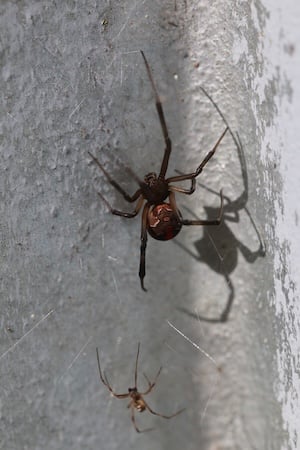
red stripe and white markings
Redback spider mating ritual
The redback spider mating ritual involves sexual cannibalism.2 The male spider creates a sperm package that it picks up in its pedipalps. When the redback finds a potential mate, it approaches the female very carefully so that he doesn’t get eaten before he has a chance to mate. He will pluck the web to get her attention and approach tentatively. When close enough, the male will insert one of its pedipalps into one of the female’s spermathecae (insemination orifices). He then somersaults to present his abdomen as a potential meal. However, to prevent the female killing and eating him straight away, he constricts his abdomen.3 This gives him enough time to insert his second pedipalp into her second spermatheca, before succumbing to her bite. By completing both inseminations, he ensures no other male can mate with her. (Interestingly, this cannibalisation is only seen the redback and no other Latrodectus species – and even then, cannibalism only occurs in around two thirds of redback matings.)
Males are attracted to females through sex pheromones, which she incorporates into her web. It is not uncommon to see several males in a web, competing for the attention of the female. It is estimated that only 10-15% of males will successfully mate with a female.
Redback spider bite symptoms
The redback bite is painful, with the pain gradually increasing in the hour following envenomation, moving up the affected limb. Along with redness and swelling, there is typically sweating at the bite site – a unique feature of a redback bite. The victim can experience nausea, vomiting and abdominal pain, headaches, high blood pressure and fever.
Are redback spiders dangerous?
Redback spider bites are certainly painful and can be dangerous, but no redback bite deaths have been recorded since 1956 when the antivenom became available. However, although 14 deaths prior to 1956 have been attributed to redback bites, solid proof that the bite was the cause of death is lacking. It is interesting to note that although available, the antivenom is often not used in medical treatments of redback bites.
Redback spider bite first aid
Redback spider bite first aid follows the standard spider bite first aid – keep the victim calm, wash the bite with water and disinfectant, apply an ice pack to the bite area and take painkillers if required (although they are unlikely to eliminate all the pain). For the young, elderly or infirm, consider seeking medical assistance. Do not apply a pressure bandage.
Redback spider pest control
A comprehensive insecticide treatment to known and potential hiding places around the property will eliminate any spiders present and protect against new spiders moving in for several months. For significant infestations, it is necessary to take time to treat all potential hiding places, for example inside each hollow vertical of tubular metal pool fencing. Spring applications provide the best performance before large numbers of egg cases have been laid. Properties with significant redback infestations are likely to have significant redback numbers outside the treated area, so the potential for re-invasion will be higher.
1 Australian Government Australian Institute of Health and Welfare. Venomous bites and stings report (2017).
2 Andrade, M.C.B (2003). Risky mate search and male self-sacrifice in redback spiders. Behavioral Ecology, Volume 14, Issue 4, July 2003, Pages 531-538, https://doi.org/10.1093/beheco/arg015
3 Andrade, M.C.B et al (2005). Novel male trait prolongs survival in suicidal mating. Biol. Lett. (2005) 1 (3): 276–279. https://doi.org/10.1098/rsbl.2005.0318