A helpful guide to choosing the right filters for your respirator.
Every pesticide in Australia must be registered for use with the Australian Pesticides and Veterinary Medicines Authority (APVMA) to ensure the product has an approved label and safety data sheet (SDS). The SDS contains detailed information about the chemical’s properties, potential health effects, safe handling and storage procedures, and emergency response actions. Understanding this information is key to choosing the right respiratory protection equipment (RPE).
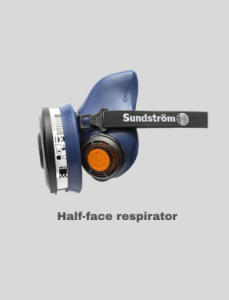
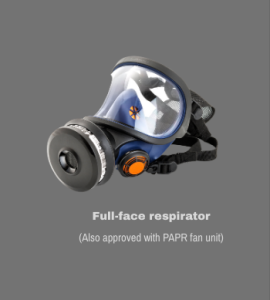
This means that on every job, pest managers should know which respirator and filter type will give them maximum protection against chemical exposure. These are generally categorised as pre-filters, particle filters, gas filters, and combination filters. All of these filters can be used with half-face or full-face respirators.
What are pre-filters?
A pre-filter captures coarse dust and particles, which prevents large particles from prematurely clogging the main filter. When the pre-filter is changed frequently it extends the life of the main particle, gas and combination filters.
What are particle filters?
Pest managers working with dusts and sprays will require particulate filters for their respirators, usually as part of a combination filter due to the presence of organic solvents. There are three classes of particulate filter:
- Class P1 – intended for use against mechanically generated particulates e.g. from grinding, sanding, drilling and sawing;
- Class P2 – intended for use against both mechanically and thermally generated particulates e.g. welding fumes and bushfire smoke;
- Class P3 – intended for use against all particulates, including highly toxic materials e.g. organophosphate insecticides.
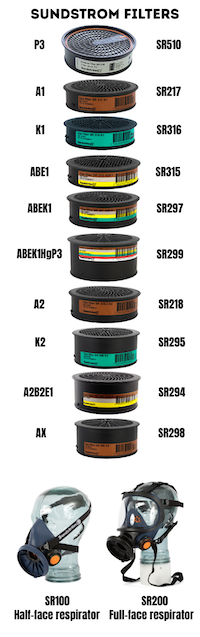
The Sundström SR510 particle filter is classified as a P3 high-efficiency mechanical filter that protects against all types of wet and dry particles including asbestos fibres, coal dust, silica dust, lead fume, oil mist, mould, bacteria and viruses.
Each filter is tested twice during manufacture for 99.997% filtration efficiency. It has a 1300cm2 filter area, giving the filter an extremely low breathing resistance, in this case 70% lower than standard requirements. The same filter fits on all Sundström filter respirator products. Pest managers should note that a higher-class P3 filter also covers the lower filters (i.e. P3 covers both P1 and P2).
How often should I change prefilters and particle filters?
There is no specific cleaning regime for filters, however the use of a respirator must be part of a respiratory protection program (see AS/NZS 1715:2009), which includes regular inspection and servicing of the respirators. All respirators and filters must be inspected before use to ensure they are serviceable and undamaged. Filters are consumables with a limited-service life; a filter with visible damage must immediately be scrapped. Every workplace is unique and filter life must be assessed based on each user’s work and environment, and the nature of the pollutant. This is applicable for particle and gas filters.
Particle filters should be replaced as soon as there is any noticeable increase in breathing resistance, or if the filter has been damaged in any way. There is no precise gauge as to how long a particle filter will last, but a guideline is 4-6 weeks (160-240 hours), provided pre-filters are also used.
In summary: when an increase in breathing resistance occurs, it is recommended to change the pre-filter first. The particle filter should be changed when it becomes harder to draw air.
What are gas filters?
Pest managers who work with toxic gases, such as methyl bromide, or pesticides that produce organic vapours, should ensure that their respirators are fitted with the appropriate type of gas filter. Gas filters are made for specific chemical types but the two most commonly required for pest control are:
- Type A – for use against organic gases and vapours (e.g. many of the solvents used in common pesticides)
- Type AX – for use against methyl bromide.
Once a pest manager has determined the type of gas filter required (A or AX), the right class of filter is then required. The classification of gas filters is different to the classification of particulate filters; gas filters are divided into class 1 and class 2 based on the concentration of gases in the air and the maximum concentration of gas or vapour the filter can protect against.
The filters are colour coded and classified as follows:
- A: Organic vapour (boiling point > 65°C)
- B: Inorganic gases (e.g. chlorine, hydrogen sulphide)
- E: Acid gases (e.g. sulphur dioxide, hydrogen chloride)
- K: Ammonia and amine derivatives.
Sundström offers gas filters for protection against all types of contaminants such as the SR217 against A1 organic gas or the SR218 against A2 organic gas and vapour most commonly used by pest control professionals. Gas filters are filled with one or several layers of activated and/or impregnated carbons depending on what type of gases the filter is intended to protect the user from.
What are combination filters?
Combination particulate and gas filters provide dual protection. Pest managers will most often use a respirator with a combination class particulate and Type A gas filter. This is because many commonly used pesticides generate droplet particulates but have solvents that produce organic vapours.
Pest managers often use the Sundström combination ABE gas filters such as the SR315 against ABE1 gas or the SR299-2 against ABEK1HgP3 which protects against most gas contaminants and particles.
How should I store my gas filters?
Gas filters continue to absorb contaminants in the air even when they are not being worn with a mask. It is important to store gas filters in an air-tight container because the filter material will continue to absorb airborne contaminants. An airtight seal prevents this passive absorption of gases, moisture, and other contaminants, which maintains the filter’s effectiveness and extends its shelf life. Sealed packaging should not be opened until the new filter is needed.
How long will a gas filter last?
It is much more difficult to assess when a gas filter needs replacement compared with a particulate filter. Gas filters should be replaced according to a carefully documented change-over schedule, based on the concentration of contaminant, temperature, humidity and workload. It is very important to change the filter before it becomes saturated.
Users should be aware of taste or smell occurring while wearing the mask, as this indicates the end of the life of the filter.
More information about Sundström filters can be found on the Safety Equipment Australia website.
Main image credit: Affordable Pest Control