Dr Thomas Chouvenc, Associate Professor of Urban Entomology at the University of Florida, explains the role of cannibalism within termite colonies.
Life, carbon and nitrogen
All organisms living on this planet have evolved as a result of using the available environmental resources to optimise their survival and reproduction. Taking an evolutionary perspective, an organism with the ability to tap into resources that were previously inaccessible allows for dominance of a particular niche with subsequent diversification. In termites, the acquisition of lignocellulosic protists from their woodroach ancestor opened up a beyond-reach resource for most, which had accumulated in the environment since the beginning of the rise of plants during the Carboniferous: wood.
The success of primitive termites around 150 million years ago was down to their ability to unlock and utilise the carbon sequestered within plant material, which had remained out of reach to most metazoans. This allowed them to conquer many parts of the world, leading to species diversification. Today, termites are one of the major sources of animal terrestrial biomass because of this ability to access wood resources. In fact, it is hypothesised that the emergence of termites accelerated wood decomposition processes, which ultimately led to the cessation of coal and oil sediments, making fossil fuel stocks finite.
While life as a whole relies on carbon chemistry, where a carbon skeleton creates the backbone of molecules used by organisms, other complementary elements remain critical for the proper existence of life: oxygen, nitrogen, hydrogen, sulphur, and many other elements. Ultimately, C-N-O (carbon, nitrogen, oxygen) represent the bulk of organic matter on earth. All organisms will optimise their access to these elements in complex organic chemical cocktails, via their food source, and often through the help of symbiotic partners.
For example, plants are able to transform the energy from the sun through the help of their chloroplasts to grow and reproduce, while converting atmospheric CO2 into a lignocellulosic matrix so as to grow as high as possible to compete for sunlight. As a result, wood is extremely rich in carbon, and extremely poor in nitrogen. However, most animals require a complex chemistry that uses nitrogen-rich proteins for their development and reproduction. So, how can beef become such a nice protein-rich steak while feeding exclusively on grass, which is mostly carbon-based? By eating a lot of it and by excreting a lot of waste. Big volumes in, big volumes out, while sequestering the good stuff. Termites do the same. But they have a few additional tricks.
For termites and their ancestors, their nitrogen-deficient diet has always been a limiting factor for colony growth (Nalepa 1994), and lineages have adopted various solutions to this issue. Some termite lineages co-opted the help of diazotrophic bacteria in association with their protist fauna (Okhuma 2003), so as to be able to fix and assimilate atmospheric dinitrogen (N2). To make this abundant nitrogen available to the metabolic chemistry of the termite, it takes a vast amount of energy.
Luckily for termites, with their relatively slow developmental rate and a virtually unlimited access to wood, they have enough fuel to assimilate this expensive nitrogen, working as a finely tuned machine. Alternatively, many termite lineages have instead switched to supplementing their wood diet by ingesting rich organic soil layers. This allows termites to acquire their nitrogen trophically through these soils and associated nitrogen-rich microbiomes (Mullins et al. 2021). Ultimately, several lineages in Termitidae have completely switched to a soil diet.
Termite, conservation and cannibalism
The challenge of nitrogen acquisition in termites is somewhat resolved, ensuring their growth and reproduction, albeit with many associated costs and trade-offs. However, there remains a major problem for growing colonies: retaining and conserving this nitrogen, so as to avoid wasteful investments. Indeed, nitrogenous molecules are precious resources that must be maintained within the system, so as to minimise the ongoing associated cost of acquiring more, and to optimise colony growth. In large colonies with a high birth rate, there is also an inherent natural mortality rate of older individuals. Colonies can therefore go through large demographic turnover over the years, with potentially millions of termite deaths and millions of newborns (Chouvenc et al. 2022). Termites have therefore perfected a recycling strategy for nitrogen conservation over evolutionary time to avoid any waste: systemic cannibalism.
To date, it is assumed that all termite species perform a colony-wide process of cannibalising their sick, moribund, and dead individuals. This is most likely a key trait acquired prior to the ancestor of termites and maintained in all extant termite lineages. Of course, this behaviour has received extensive scrutiny by termite researchers around the world because it is so common and evident in termites that one can’t ignore it. Fun fact: when you study the survival of a group of termites in an experiment, you have to count the live termites, not the dead ones, simply because there is rarely a dead body lying around; it is usually rapidly cannibalised by nestmates. The concept of a ‘refuse pile’, which can be rather crucial in ants, is mostly useless in termites, as everything goes through someone’s gut, eventually (Chouvenc et al. 2009). The colony has a social stomach, Soylent Green style (it’s a 1973 movie, if you want to check the meaning).
Cannibalism in termites is therefore an essential part of the cycle of nutrients within the colony. It allows precious resources like nitrogen to be reused by the termite society (Konishi et al. 2023). This behaviour also performs secondary functions such as sanitation and reducing the risk of diseases within the social group.
The consumption of ‘self’ is not limited to the dead termites. As workers come back to the central part of the nest when it is time for them to moult, they initiate ecdysis near the area of the king and queen, as it is the safest place to moult and receive the care of the nurses (young workers) residing in this area. The shed exuvia (moulted cuticle) is then consumed by the helping workers, which can then be reconverted into a nitrogenous resource. This is ultimately fed back to the queen to boost her egg-laying activity (Tasaki et al. 2023, Tong et al. 2023). To summarise: termites eat their dead, and also the last vestiges of their living, so as to help regenerate the colony with a new cohort of young individuals. Somewhat gory, but darn efficient.
Termite, starvation and cannibalism
Interestingly, cannibalistic behaviours can also be seen in termites subjected to a period of starvation. As soldiers are nutritionally dependent on workers, it is suggested that they would be eaten as a priority. This cannibalism would alleviate the trophic burden and recycle very precious resources toward the rest of the group. This strategy would therefore reduce the metabolic footprint of a colony with finite resources, prolonging colony survival while attempts are made to find novel food sources. However, such initial interpretation may have been erroneous (Chouvenc 2020).
To cut a long story short: termites are terrible at survival strategy during periods of starvation because, in fact, they don’t really have a strategy. Unlike honeybees that store months-worth of honey, most termite species have a carpe diem (seize the day) approach to food security, as they have no internal reserves. Instead, some termite species will relentlessly (and most of the time successfully) forage for new food sites to prevent food shortage in the first place. But if starvation actually occurs, the colony doesn’t have much of a survival strategy. Give it about 30 days.
As the colony is progressively running out of fuel (carbon), nutritionally stressed individuals begin to accumulate. Unfortunately for termite larvae and workers, who are hemimetabolous insects stuck in a permanent juvenile moulting cycle, the time to moult eventually comes, and the younger the instar, the faster the moulting cycle (Kakkar et al. 2018). Have you ever tried moulting while completely starving? It is not advisable. The unavoidable result is a failed attempt to moult, leading to death and subsequent cannibalism by nestmates.
The brood and young workers are the first ones to be eaten, not as survival rations for the group, but because they are the first ones to die during their moulting process. Then soldiers start running out of juice faster than some of the older workers (who have yet to attempt moulting), as they are fed second-hand by workers. Indeed, the remaining workers have to maintain their own metabolism and have nothing left to share with the soldiers, resulting in moribund soldiers, and subsequent cannibalism. Finally, towards the end, a handful of old workers remain, with the king and queen being the last ones to inevitably die of starvation (Chouvenc 2020). So, if termites actually have a survival strategy during starvation, it is this: “keep the king and queen alive as long as you can”. Any remaining available energetic resources are eventually funnelled to them.
Thus, contrary to previous perceptions, termites don’t reduce the trophic burden of the colony by cannibalising the dependent castes. Mortality is not cannibalism-driven; instead, cannibalism is mortality-driven. Termites just do what they always do: if a dead or moribund individual shows up in the group, it is cannibalised to recycle the nitrogen. This is an inherent behaviour that was reinforced over millions of years of a nitrogen-deficient diet.
The fact is, cannibalising an energy-depleted individual does not provide much energy to the group. The excessive mortality resulting from starvation triggers a massive cannibalism wave, which ends up with the accumulation of old workers with staggering levels of uric acid building up in their fat body (a way for roaches and termites to store nitrogen). Such an observation is typical of termite colony collapse, as there is a sudden excess of available nitrogen through cannibalism, something termite metabolism never evolved to manage.
Termite baiting, cannibalism and useless recycling
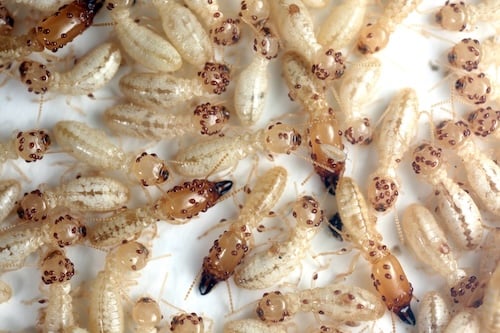
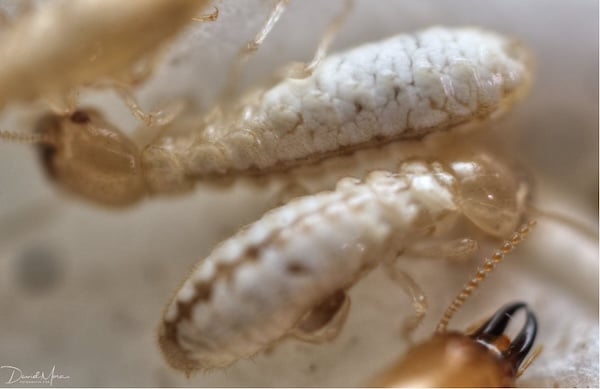
The observation of workers filled with uric acid within their fat body (unusually white abdomens) is not uncommon for pest managers using chitin synthesis inhibitor (CSI) baits for the elimination of subterranean termite colonies. Pest managers will often observe two things: firstly, the accumulation of a large number of soldiers; and secondly, the change in the body colour of the remaining (large) workers.
However, the observation of the rise in soldier ratio is not because there are more soldiers in the colony. It is a direct consequence of the mass dying of the worker caste who are progressively dying during their individual moulting events due to the effect of the CSI (Chouvenc 2025). Towards the end of the baiting process, soldiers are hanging in there, starving, with very few healthy workers left to feed them. The visible buildup of uric acid in the fat body of the abdomen of old (remaining) workers in CSI-baited colonies is the direct result of excess cannibalism that emerged from the initial colony collapse. Of course, this cannibalism is useless for the colony: it already has an excess of nitrogen, reproduction is terminated, and worse, it helps to further spread the CSI active ingredient within the colony. By then, the colony has already reached its point of no-return towards inevitable collapse, often accompanied by the rise of saprophytic mites within the nest system.
David Mora)
Cannibalism, cannibalism and cannibalism
Interestingly, a termite colony baited with a CSI formulation follows a similarly doomed scenario as if the colony was starving, because of the timing of moulting, its associated mortality, and subsequent cannibalism. The CSI first impacts the brood, as they moult rapidly. Then young workers follow, and ultimately older workers, which moult last. As seen with a starving colony, cannibalism remains systemic and is triggered by the accumulation of dead individuals during their respective moulting process. This is the reason why termite colonies always display workers with high levels of uric acid in their fat body when the colony engages in its senescence. Colony collapse can be a natural senescence when reproduction ends leading to the decline of the colony over 2-3 years (Chouvenc et al. 2022); an artificial senescence through starvation over 1 month (Chouvenc 2020); or an accelerated senescence from the effect of CSI baits (Chouvenc 2025). Whatever the reason is for the death of the colony, cannibalism remains a constant, and it results in the accumulation of uric acid in the fat bodies of workers.
To conclude, when you see a termite colony with a lot of its members displaying this characteristically white abdomen, you know that the colony has been going through repeated cycles of cannibalism and is likely on its way out. While cannibalism remains a vital process in the functioning of healthy growing colonies, it eventually becomes an unmistakeable signal of colony demise.
Dr Thomas Chouvenc, Associate Professor of Urban Entomology at the University of Florida
This piece is a new take on an article originally published in the Insects Sociaux blog in 2019, by the same author.
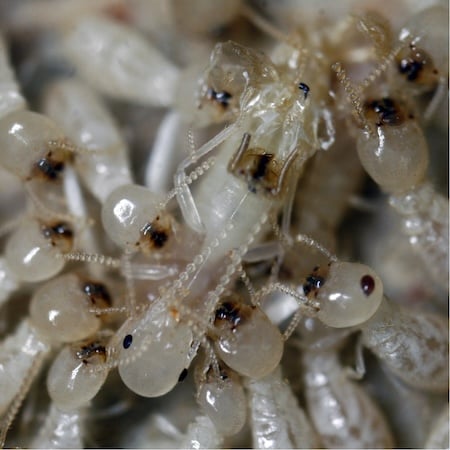
Main image above: Individual Reticulitermes sp. termite being cannibalised by co-workers (photo credit: David Mora)