Peter Brigden, General Manager at Termseal Australia, explains how to take an integrated approach to termite management, highlighting key areas of protection that are frequently overlooked.
Termites remain one of the greatest threats to Australian residential construction. With subterranean termite species active across most of mainland Australia, effective termite management is no longer simply a pest control issue; it is a critical component of building design, compliance, risk management and asset protection.
For builders, designers and specifiers, termite management begins long before handover. It starts during the planning phase, where the selection of compliant termite management systems can significantly influence construction efficiency, long-term building performance and homeowner confidence.
Understanding the AS 3660 framework
The primary Australian Standard governing termite management is AS 3660, a multi-part standard covering termite management systems for both new and existing buildings. AS 3660.1 specifically addresses the design and construction requirements for subterranean termite management systems in new building work and is referenced by the National Construction Code (NCC) for residential construction in termite-prone areas.
The standard establishes requirements for physical, chemical and combined termite management systems, inspection zones and termite detection provisions, and service penetration protection. It also outlines the documentation and durable notices that are required as well as long-term system performance expectations.
The objective of AS 3660.1 is not necessarily to prevent termites from entering a property but to deter concealed entry and provide opportunities for detection before structural damage occurs.
The challenge of modern construction
Contemporary building methods often present multiple termite entry points that require careful consideration. Concrete slabs constructed in accordance with AS 2870 and AS 3600 are recognised as part of an effective termite management system. However, service penetrations, construction joints and slab interfaces create potential pathways for termite ingress if not properly protected.
This has increased demand for integrated systems capable of protecting these most vulnerable areas, such as slab and pipe penetrations, construction and expansion joints, isolated piers and moisture-prone building elements.
Builders have told us that they are seeking solutions that can be installed efficiently while maintaining compliance with AS 3660 requirements.
The integrated Termseal approach
We have developed a range of termite management systems designed to address the practical realities of Australian construction. At Termseal, we believe that no single product can address every construction scenario, which is why we promote an integrated system approach that can be adapted to varying construction methods and site conditions.
For builders and specifiers, this offers greater flexibility when dealing with challenging situations such as split-level sites, brick veneer construction, or suspended or raft slab construction. A key advantage is the ability to combine termite management with moisture protection requirements, reducing trade coordination challenges and simplifying installation sequencing.
Three particular areas of the property are critical for compliance: service penetrations, slab joints, and the slab perimeter.
Service penetrations
One of the most overlooked aspects of termite management is the treatment of service penetrations. Industry experience consistently shows us that plumbing penetrations are one of the most common concealed entry points for subterranean termites. Because termites naturally follow moisture sources and underground services, plumbing penetrations often become preferred access routes beneath slabs. Our technical guidance highlights the importance of AS 3660-compliant penetration collars and detailing around every service penetration.
Concrete slab joint protection
Often overlooked are the joints engineered in slabs, especially saw-cut contraction joints. Saw-cut contraction joints are engineered crack-control features. The saw cut creates a weakened plane that induces a shrinkage crack to form beneath the cut. Therefore, while the joint is installed after placement and appears as a surface groove, its intended function is to create a through-depth crack at a controlled location, which may represent a potential concealed termite entry pathway if not properly managed.
For termite management, understanding the function and behaviour of this construction feature is important. Although the joint may appear to be merely a shallow groove in the surface, the intended performance of a contraction joint depends on the formation of a crack beneath the groove. That crack can potentially create a pathway through the slab, particularly if the joint opens, experiences differential movement, or is not properly protected by a termite management system.
Our technical manual offers several installation methods for protecting joints from concealed termite entry.
For builders, inadequate attention to slab control joints can create compliance risks, inspection issues and future liability concerns.
Concrete slab perimeter protection
Slab edges are recognised as a significant termite risk area because they commonly contain joints, cracks, interfaces, and opportunities for concealed shelter tube construction.
To address this, a full, complete and compliant termite management system should be installed during the construction phase. Installation at the correct stage of construction is critical.
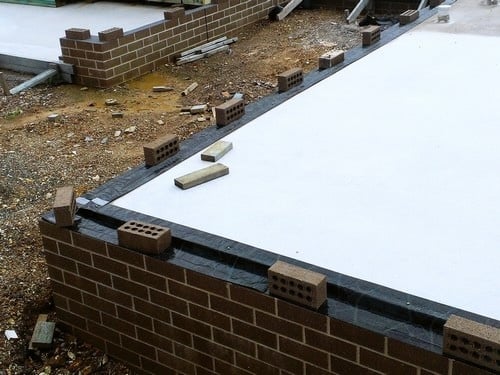
Typically, Termseal’s Ura-Fen Shield Termite and Waterproofing Barrier tri-layer sheeting is installed to the slab edge before the timber/steel frame is erected. If installed correctly, once the bricks are laid, the outer edge of Termseal Ura-Fen Shield TWB is visible in the outer face edge of the brickwork, spanning the cavity to impede termite entry. The main image above shows Termseal’s Multi-purpose Active Termite and Waterproof Barrier being used at the base of a perimeter wall.
Performance and certification
Builders and certifiers are required to demonstrate compliance with the performance requirements of AS 3660.1 and NCC provisions. Independently verified termite management systems are an essential part of meeting those obligations; it is not an optional upgrade.
Our termite management products have undergone independent testing and are supported by CodeMark certification for relevant applications. Our systems have been tested to comply with AS 3660.1-2014 requirements for new building work when installed in accordance with our specification requirements.
For specifiers, this third-party certification provides additional confidence that our systems satisfy regulatory requirements and can simplify documentation during approval processes.
Beyond compliance: delivering long-term value
While code compliance remains essential, today’s clients increasingly expect long-term building protection.
Termite damage is frequently excluded from standard home insurance policies, meaning property owners often bear the full cost of repairs. As a result, termite management systems have become a significant selling point for builders seeking to differentiate themselves in competitive markets.
An effective termite management strategy should begin with a design-stage risk assessment, leading to an AS 3660-compliant plan that uses certified termite management systems. After installation, durable notices and documentation must be provided, and a plan recommended for ongoing inspection. This integrated approach provides protection not only for the building but also for the builder’s reputation.
The future of termite management
As building envelopes become more complex and energy-efficient construction techniques continue to evolve, termite management systems must adapt accordingly.
The industry is moving toward integrated solutions that combine termite protection, moisture management and compliance requirements into a single coordinated system. For builders and specifiers, this reduces installation complexity while improving long-term performance outcomes.
At Termseal, our product range demonstrates how modern termite management has evolved from simple chemical barriers to sophisticated building protection systems that support both compliance and durability objectives.
For Australian builders operating in termite-prone regions, the message is clear: termite management should never be viewed as an afterthought. When incorporated early in the design process and installed in accordance with AS 3660 requirements, integrated systems can provide lasting protection, simplified compliance and greater confidence for both builders and homeowners.
Builder’s termite management system checklist
✓ Confirm whether the site is located in a termite-prone area
✓ Specify termite management systems during design development
✓ Ensure all slab penetrations receive compliant protection
✓ Ensure all slab construction and control joints receive compliant protection
✓ Ensure the slab perimeter is complete, continuous and compliant
✓ Verify system certification and compliance documentation
✓ Coordinate termite management with waterproofing and service trades
✓ Install durable notices as required by NCC
✓ Provide owners with maintenance and inspection recommendations
✓ Maintain comprehensive installation records for handover
Peter Brigden, General Manager, Termseal Australia