
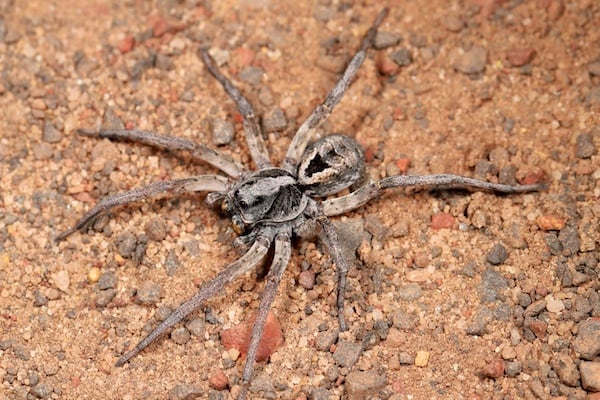
Wolf spiders (Lycosidae species)

wolf spider

Pest Snapshot - Wolf Spider

  • Scientific name: Lycosidae family
  • Identification: A large number of species. Fast moving ground spider. Size varies from 1-8 cm depending on species. Black, grey, brown patterned spider. Eyes in 4+2+2 arrangement.
  • Health threat: Low
  • Bite pain: Mild
  • First aid: Standard spider bite first aid.
  • Web description: Do not produce webs.
  • Where do they live? In leaf litter or burrows depending on the species.
  • Main pest season: More common in warmer months.
  • Indoor/Outdoor pest: Indoor invader
  • Difficulty to control: Focus on exclusion from buildings.

Wolf Spider Information

Wolf spiders are a fast running ground spider.

The leg span varies by species and can be anywhere between 1 – 8 cm.

The colour varies predominately a combination of browns, greys and black, sometimes with white and yellow, often in patterns / strips on the thorax and abdomen. including white and yellow.

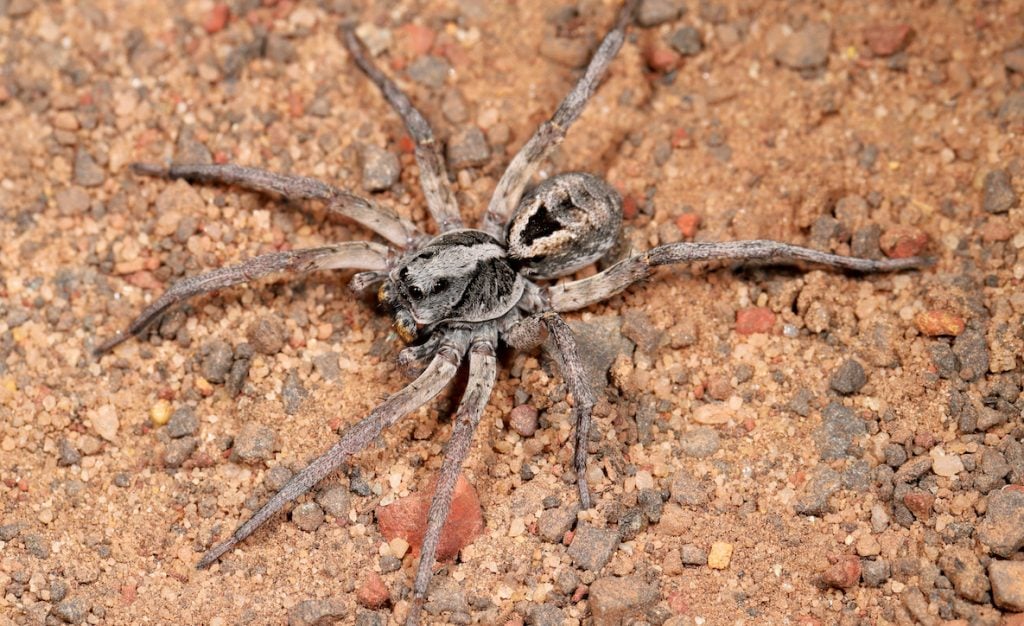
Wolf spiders have a unique eye arrangement – 8 eyes in three rows in a 4:2:2 arrangement with four small eyes in a row above the fangs and the four larger eyes in a square further back on the head. The middle row of two eyes on the top of the head can be significantly larger than the rest.

wolf spider with 4+2+2 eye arrangement

Wolf spiders do not build webs, although some will build burrows in which they hide during the day (they are night hunters). These burrows can be up to 25 cm deep, with some species also building a trapdoor to close the opening, which is why they sometimes get confused with trapdoor spiders.

Mating:

Male wolf spiders locate a female burrow by odour. They perform a series of leg and palp movements as part of a courtship ritual prior to mating and mate outside the burrow during the night.

Eggs:

The female produces a ball shaped egg sac which she attaches to her spinnerets and thus carries around with her.

Wolf spider spiderlings:

When the eggs hatch, the spiderlings ride around on the female’s back until they are ready to disperse.

Life-span:

Wolf spiders generally live for around a year.

Wolf spiders are found across Australia. They are ground spider found in the leaf litter and in burrows. In urban areas they are common in lawns and gardens.

Wolf spiders prey on ground dwelling invertebrates, but will attack small vertebrates. Indeed, two species of wolf spider are known to eat cane toads.

Wolf spiders are everywhere and there is little in the way of preventative measures, other than ensuring doors and screens are well fitted to minimise entry into buildings.
Wolf Spider Bite Information

Wolf spiders are not seen as harmful to humans.

Symptoms:

  • Generally mild bite with localised pain / itchiness

  • In occasional more severe reactions there may be prolonged pain, dizziness and nausea

The recommended treatment for wolf spider bite is to carry out spider bite first aid, supplemented with pain killers

First Aid:

  • Keep the victim still (sit down or lie down)
  • Apply an ice pack to the bite area
  • (Capture or take a photo of the spider for identification)
  • Seek medical attention
    • if the victim is young, elderly or infirm
    • if pain is severe
    • if victim has a severe reaction (anaphylactic shock or collapse)

Medical disclaimer: The information provided on this website is for educational purposes only and does not substitute for professional medical advice. If in doubt about identifying the spider or understanding the required first aid, seek medical attention immediately. ff the victim experiences a significant reaction to the bite (no matter which spider), seek medical help immediately.

In case of emergency call 000. If uncertain about what to do call the Poisons Information Line 13 11 26.

How to get rid of wolf spiders?

To be honest you don’t really want to get rid of wolf spiders – they do a lot of good in the yard and garden getting rid of pests.

The best action is to stop them entering the building, Keeping vegetation away from the perimeter of the building and ensuring tight fitting windows and doors are key actions.

There is no specific treatment for wolf spiders. The general strategy to keep wolf spider numbers down around a property is to carry out a general pest treatment to eliminate potential prey.


Wolf Spider FAQ

Wolf spiders will bite but only if they are picked up. They have no interest in humans and quite a timid spider. 

Wolf spiders are not considered a dangerous spider – they will generally run away and if bitten, their bite is only mildly painful.

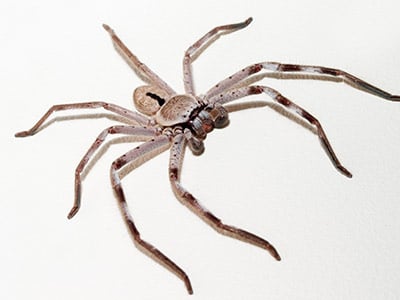
To the trained eye wolf spiders can sometimes be confused with huntsman spiders. Both are fast moving hunting spiders, often similar colouration. However, there are a few difference that can be used to tell them apart:

  • Both spiders have 8 eyes, but wolf spiders have their eyes in a 4+2+2 arrangement, with huntsman eyes set in 2 rows of four.
  • Wolf spiders spend almost all of their time on the ground. Huntsman spiders are comfortable hunting on vertical surfaces and even upside down.
  • Wolf spiders have “normal” shaped lges, huntsman legs are forward pointing, giving it a crab-like appearance.
  • Although wolf spiders can be quite large, most species are of medium size. Huntsman are generally the bigger spider when fully grown.
wolf spider
Wolf spider
huntsman spider
Huntsman spider

Choose Your Country or Region

Asia Pacific