
White-tailed spider (Lampona species)
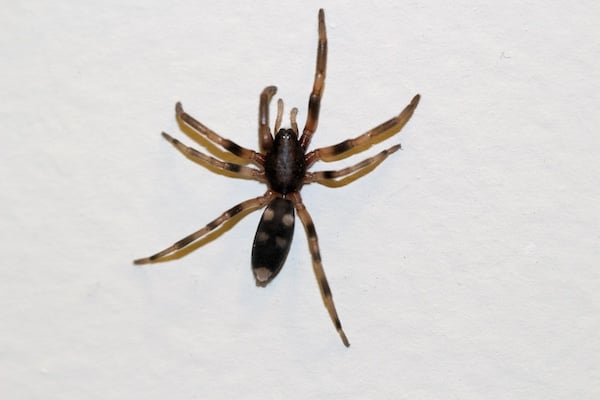
Pest Snapshot - White-tailed Spider
- Scientific name: Lampona spp.
- Identification: Black / grey body with 4 white spots on abdomen with a 5th spot at the end. Legs are pale brown with dark bands. Body up to 18mm long. Leg span up to 28 mm.
- Health threat: Medium
- Bite pain: Medium
- First aid: Standard spider bite first aid. Seek medical attention if victim experiences severe reaction.
- Web description: Do not build webs.
- Where do they live? Under bark and rocks / logs.
- Main pest season: Spring to Autumn
- Indoor/Outdoor pest: Indoors
- Difficulty to control: Difficult
White-tailed Spider Information
Identification
White tail spiders have a dark grey to black, slim and elongated body, with two pairs of faint white spots on the abdomen and a white spot at the tip. The leg coloration is dark orange / brown bands.
The female body length is up to 18 mm (leg span up to 28 mm) and the male up to 12 mm.
Do white-tailed spiders make webs?
White-tailed spiders do not build webs – they are considered a running or hunting spider.
Life-cycle
Mating
The male spider approaches the female from the front but will only approach if they get an appropriate signal from the female (otherwise they could end up being dinner!).
Eggs
The females make temporary silk retreats where she lays up to 90 eggs in a disc-shaped egg sac.
Baby white-tailed spiders
The female spider guards the egg sac until the baby white-tails or spiderlings emerge. As soon as they disperse they are off to find their first meal. These juvenile white tail spiders look like smaller versions of the adults.
Life-span
White tails spiders are not tolerant of cold weather and many die off over winter in colder areas. It is assumed they generally live for no more than a couple of years
Where do white-tailed spiders live?
White-tailed spiders are native to Australia.
There are actually two common white-tailed spider species – Lampona cylindrata and Lampona murina – which need expert identification to distinguish. Lampona cylindrata is more widely distributed, generally being absence from the more tropical areas with Lampona murina being confined to eastern Australia (from the tropics down to Victoria).
Their natural habitat is underneath bark and rocks and in the leaf litter, where they hunt for their prey. When they find their way into homes, sheets and clothing (especially left on the floor) are favoured hiding spots as they are similar to their natural resting places.
The are nocturnal emerging from their hiding places at night to hunt.
What do white-tailed spiders eat?
White tailed spiders are hunting spiders and target other spiders as their prey, with black house spiders considered their preferred prey. For this reason they are often found in and around houses in summer and autumn when black house spiders numbers are at their peak.
They are a nocturnal hunter (most active at night).
White-tailed spider bite information:
White tails have a very painful bite, however there is no evidence that the white tailed spider bite cause necrotic ulcers (where the flesh gets eaten away). There are no toxins in the white tail spider venom that can cause ulcers. Of 130 confirmed bites in a scientific study, none produced a skin ulcer.
It is believed that ulcers may form after any spider bite, and are probably due to infection from bacteria, which has been introduced into the bite through scratching, dirt or possible off the spider’s fangs.
Isbister, G.K. & Gray, M.R. 2003. White-tail Spider bite: a prospective study of 130 definite bites by Lampona species. Medical Journal of Australia 179: 199-202.
Symptoms:
The white tail spider bite causes a painful initial burning pain, followed by swelling and itchiness at the bite site.
First aid:
- Apply an ice pack to the bite area
- (Capture or take a photo of the spider for identification)
- Seek medical attention if an allergic reaction occurs
More information on white tail spider bites and white tail spider identification.
Prevention tips:
Keeping spider webs in check in around the home will reduce the number of potential prey items around to attract white-tail spiders. Keeping clothes and bedding off the floor is a good idea too!
Information on other species of spiders.
White-tailed Spider Bite Information
What does a white-tailed spider bite look like?
The bite appears as a small red lump, which is often itchy. Marks at the bite site where the jaw punctured the skin surface are not always visible.
Symptoms
White tails have a very painful bite, however there is no evidence that the white tailed spider bite cause necrotic ulcers (where the flesh gets eaten away). There are no toxins in the white tail spider venom that can cause ulcers. Of 130 confirmed bites in a scientific study, none produced a skin ulcer.
It is believed that ulcers may form after any spider bite, and are probably due to infection from bacteria, which has been introduced into the bite through scratching, dirt or possible off the spider’s fangs.
Isbister, G.K. & Gray, M.R. 2003. White-tail Spider bite: a prospective study of 130 definite bites by Lampona species. Medical Journal of Australia 179: 199-202.
Symptoms:
- The white tail spider bite causes a painful initial burning pain, followed by swelling and itchiness at the bite site.
Treatment
The recommended treatment for white-tailed spider bites is to carry out spider bite first aid, supplemented with pain killers.
First Aid:
- Keep the victim still (sit down or lie down)
- Apply an ice pack to the bite area
- (Capture or take a photo of the spider for identification)
- Seek medical attention
- if the victim is young, elderly or infirm
- if pain is severe
- if victim has a severe reaction (anaphylactic shock or collapse)
Medical disclaimer: The information provided on this website is for educational purposes only and does not substitute for professional medical advice. If in doubt about identifying the spider or understanding the required first aid, seek medical attention immediately. ff the victim experiences a significant reaction to the bite (no matter which spider), seek medical help immediately.
In case of emergency call 000. If uncertain about what to do call the Poisons Information Line 13 11 26.
How to get rid of white-tailed spiders?
The general strategy to keep white tailed spider numbers down around a property is to treat for webbing spiders such as black-tailed spiders and redback. A professional pest treatment which delivers a broad perimeter spray and targeted crack and crevice treatments will provide long lasting control. By eliminating webbing spiders which are the favoured prey of white-tailed spiders, the property becomes less attractive to white-tailed spiders.
Sometimes a property may have a specific problem with white-tailed spiders. A professional pest control treatment is likely to deliver the best results due to the products they use and the ability to apply a comprehensive treatment, along with their knowledge of potential hiding spots. Knowing that they prefer tight spaces (under bark, rocks and in leaf litter), the pest manager will carry out a thorough inspection to identify potential “colonies”. They are likely to also to look in sub-floors and also consider wall voids. As well as sprays, they may also use insecticide dust in wall voids and cracks and crevices.
Tp prevent future infestations, keeping vegetation away from the perimeter of the building and ensuring tight fitting windows and doors will help.
Remember, an infestation at a property could be the result of a single female hatching her eggs in the vicinity.
White-tailed Spider FAQ
Are white-tailed spiders dangerous?
White-tail spider bites deliver a painful bite so should be avoided. However, they rarely have any long term ill affects, so are not considered particularly dangerous.
Can a white-tailed spider kill you?
There have been no reported deaths due to white-tailed spider bites, either from the bite or any allergic reaction. The venom is not particular harmful.
Do white-tailed spiders travel in pairs?
Some people have observed white tail spiders travelling in pairs. They don’t travel in pairs. White tail spiders may be found in close proximity when mating – males seek out females. In cases of severe infestations, there can be more than one white tail in close proximity.