
St Andrew’s cross spider (Agriope keyserlingi)
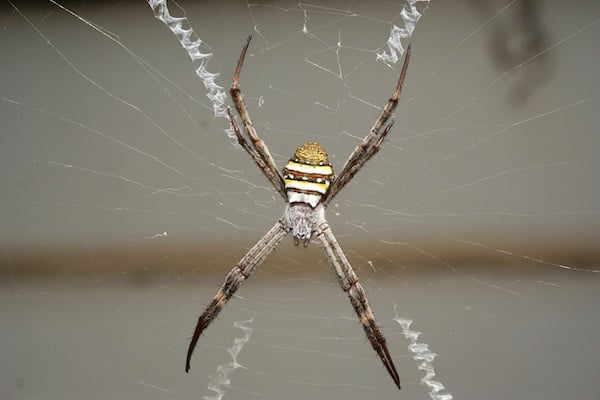
Pest Snapshot - St Andrew's Cross Spider
- Scientific name: Agropie keyserlingi
- Identification: Medium sized spider with yellow, white and brown horizontal strips on abdomen. Waist in centre of web with legs paired up to form a cross. Body up to 15mm long. Leg span up to 30mm.
- Health threat: Low
- Bite pain: Mild
- First aid: Standard spider bite first aid. Seek medical attention if victim has a severe reaction.
- Web description: Large “invisible” web suspended between plants, except for a few dense white stripes of silk near the centre (with zig zag pattern)
- Web locations: Bewteen bushes / plants
- Main pest season: Spring to Autumn
- Indoor/Outdoor pest: Outdoors
- Difficulty to control: Easy
St Andrews Cross Spider Information
Identification:
The St Andrew’s cross spider can have a body length of up to 15 mm, but the legs can be significantly longer. They have obvious yellow, white and brown horizontal stripes across the abdomen and have the habit of resting in the middle of their webs upside down, with their legs grouped in pairs to form a cross (as in the flag of St Andrew – flag of Scotland).
The St Andrew’s cross spider sits in its web during the day and retreats to a hiding spot at night.
Web:
The St Andrew’s cross spider produces a fairly unique web. Although for the most part it’s invisible, the spider creates a visible cross of white silk (often with a zig zag pattern) in the middle of the web. These think areas of silk called stabilimenta reflect UV light and help in attracting insect prey. It is also hypothesised that it helps prevent larger animals such as birds from flying into the web.
St Andrews Cross Spider Web
The St Andrew’s cross spider produces a fairly unique web. Although for the most part it’s invisible, the spider creates a visible cross of white silk (often with a zig zag pattern) in the middle of the web. These think areas of silk called stabilimenta reflect UV light and help in attracting insect prey. It is also hypothesised that it helps prevent larger animals such as birds from flying into the web. The webs are typically strung between bushes or plants.
Life-cycle
Mating:
The male St Andrew cross spider is significantly smaller than the female and lacks the bright colouring. They are found on the edges of the females web, sometimes in a smaller web nearby. When attempting to mate, the male produces a thread of silk – a mating thread – which it attaches to the female’s web and vibrates it to gain her attention.
Eggs:
The female lays up to 1400 in a pear shaped egg case suspend in threads of silk at the edge of the web or hidden among leaves.
St Andrew’s cross baby spiders:
The baby spiders or spiderlings hatch from their eggs in Autumn but stay within the egg sace over winter, emerging the following spring.
Life-span:
St Andrew’s cross spiders live for about a year.
Where are St Andrew's cross spiders found?
St Andrew’s cross spiders are a “garden spider”, although their natural habitat are the forested areas and heathlands of the east coast of Australia.
St Andrew’s cross spiders are generally viewed as a beneficial spider. Although they are not really a pest spider, they are viewed as an annoyance to some people, as they build their webs across paths and to arachnophobes they can be a bit scary due to their size.
What do St Andrews cross spiders eat?
St Andrew’s cross spiders will capture a wide range of flying insects.
Prevention tips:
Removing or trimming back vegetation from the perimeter of the building and adjacent to paths and driveways will minimise the chances of bumping into a web.
St Andrew’s cross spiders are viewed as beneficial spiders, so it is better to manage them rather than spraying them with insecticide.
Other types of spiders.
St Andrews Cross Spider Bite Information
Symptoms
St Andrew’s cross spiders are considered harmless to humans. It will generally only bite in self-defence. It’s bite is quite mild, no worse than a bee sting. Although, as with any bite or sting, those who may suffer allergies should seek medical attention if they suffer an allergic reaction after being bitten.
Symptoms:
- Localised mild pain
Treatment
First aid:
- Apply an ice pack to the bite area
- (Capture or take a photo of the spider for identification)
- Seek medical attention if the victim has a severe allergic reactions or if symptoms persist
Medical disclaimer: The information provided on this website is for educational purposes only and does not substitute for professional medical advice. If in doubt about identifying the spider or understanding the required first aid, seek medical attention immediately. ff the victim experiences a significant reaction to the bite (no matter which spider), seek medical help immediately.
In case of emergency call 000. If uncertain about what to do call the Poisons Information Line 13 11 26.
How to get rid of St Andrews Cross Spiders?
St Andrews Cross spider is a beneficial spider in the garden and relatively harmless to humans. Rather than treat for St Andrews cross spiders, it is far better to simply trim back vegetation in the araes where they building their webs – adjacent to paths and driveways.
Should this not be possible for any reason a professional spider spray targeting vegetation around the webs will control the spiders, but will also kill other insects. Spraying shouldn’t take place if there are honeybees or flowering plants in the area.
If the treatment is taking place later in the summer, the surrounding vegetation should be checked for egg sacs. These should be physically destroyed to prevent a problem the following year.