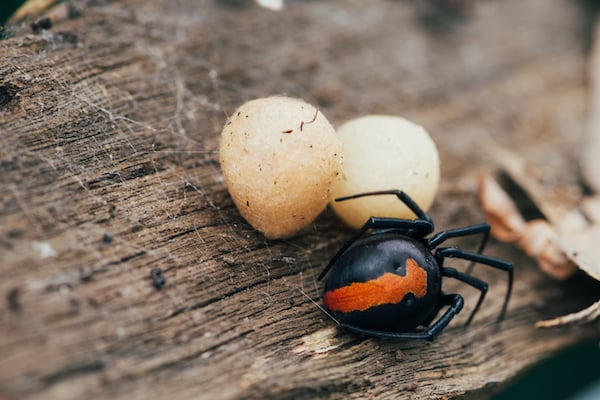
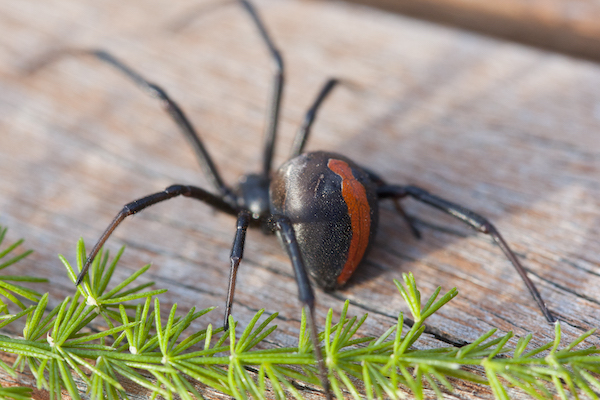
Female: Body up to 10 mm
The female redback spider is the recognisable redback – a glossy black, spherical body, with a prominent red stripe on the upper side and an hour glass shaped red or orange stripe on the underside. The front pair of legs are significantly longer than the others.
There are colour variations. Sometimes they are more of a brown colour and sometimes the red stripes are broken. The juvenile redbacks have additional white marking on the abdomen.
Male: Body 3-4 mm
The male redback is significantly smaller than the female and the markings are less distinct – often more brown in colour with broken red and white markings.
The redback spider web is a messy tangled web, a bit like a badly made fishing net. There are often dried leaves or other debris entangled in the web.
The mating of the redback spider is somewhat infamous as indeed, the male spider often dies in the act of mating! Males spider do not spin their own web but tend to hang around the perimeter of female’s web, not only picking up bits of food but assessing the right time to try and mate. The mating ritual is quite elaborate as the male needs to get close enough to mate without being eaten first. Once close enough, he does a headstand and offers his abdomen to the female as a distraction, as he inserts his mating palps. Most males do not survive this process!

Redback females produce egg sacs which contain up to 250 eggs. These egg sacs are suspended within the webs.
The baby redbacks or spiderlings hatch from their eggs within a couple of weeks but remain inside the egg sac until after their first moult. They then disperse by ballooning, by producing a line of silk which they allow the wind to catch and carry them away.
Female redbacks mature after about four months and can live for a couple of years. Males only live for around 6 months (before they are eaten during the mating process!).
Redback spiders (redbacks) are found throughout Australia. They are one of the most common causes of spider bite as they thrive in disturbed areas around buildings. In their natural environment they are typically found under rocks and logs but around the home they are found”
Redbacks will capture and feed on a wide range of insects and other spiders. However they will eat whatever they can catch in their web, including small lizards and even mice.
The redback is a close relative of the katipo found in New Zealand and the black widow spiders found in the US.
Other than keeping rubbish and stored goods away from the perimeter of the property, the only way to eliminate a redback problem or prevent them building their webs is with a professional pest treatment.
Information on other types of spiders.
The key reaction at the bite site is redness, swelling and sweating. The classic double puncture wound seen with many spider bites is only seen in about 5% of redback bites (as their fangs are quite small)
Only the female redback bite is dangerous. Redbacks rarely leave their webs, so receiving a bite is normally through accidental contact.
It is important to remember that a redback bite is a painful bite and so pain management is important (see treatment).
The symptoms experiences by individual can vary greatly. However, the pain and other symptoms for the first 24 hrs can be very uncomfortable, even with pain management. Symptoms should start to subside after 24 hours, but some symptoms can continue for several weeks. If symptoms continue for more than a few days, consult your doctor.
An anti-venom has been available since 1956 and only one death to a redback bite has potentially occurred since its introduction.
However, a recent study has suggested that there was no significant difference in the outcomes from patient receiving the anti-venom versus patients receiving a placebo. This would suggest that it is the quality of medical car rather than the availability of anti-venom that has reduced fatalities from redback bites.
The recommended treatment for redback spider bite is carry out spider bite first aid, supplemented with pain killers. However, if the pain killers have no effect or the victim suffers a severe reaction, it is important to seek medical help.
Medical disclaimer: The information provided on this website is for educational purposes only and does not substitute for professional medical advice. If in doubt about identifying the spider or understanding the required first aid, seek medical attention immediately. ff the victim experiences a significant reaction to the bite (no matter which spider), seek medical help immediately.
In case of emergency call 000. If uncertain about what to do call the Poisons Information Line 13 11 26.
A professional redback spider treatment starts with a good inspection to ensure all webs and potential hiding places are treated.
Typically, a professional treatment will consist of a thorough perimeter spray, focusing on cracks and crevices, as well as fencing. Sub-floors and roof voids may also need to be treated.
Spraying webs and hiding places with a suitable residual spray will achieve excellent results. Bifenthrin based products have an excellent reputation as a long lasting spider treatment. In areas unsuitable for spraying, such as downlights, professional will often apply an insecticide dust instead.
Most professional pest managers will ofter a 6-month warranty on web-building spiders, such as the redback.
Webs can be removed 2-3 days after the treatment. Any webs should be brushed down and not washed away with water, as it will also wash away the insecticide, reducing the duration of protection.
Redback spiders are certainly dangerous, but will modern clinical care, death from a redback bite is highly unlightly. There has only been one possible death from redback bite in the last 70 years (in 2016). For most bite victims first aid treatment at home is sufficient but for the young, elderly or infirm, it is important to seek medical attention.
The redback spider and black widow spider are not the same, but they are related (same genus). The redback is native to Australia and the black widow is native to America. The redback has an obvious red stripe on the back of its abdomen, the black widow does not.
The Katipo spider in New Zealand, also belongs to the same genus.
Dogs and cats are more susceptible to the venom in redback bites, partly due to their small size. Bites to small / young dogs and cats can be fatal. The anti-venom can be particularly important in treating cats.
Dogs and cats are often bitten on their tongue as they try to bite / play with their spider, which can also make the symptoms more severe.
If you believe your pet has been bitten by a redback, take it to the vet immediately.