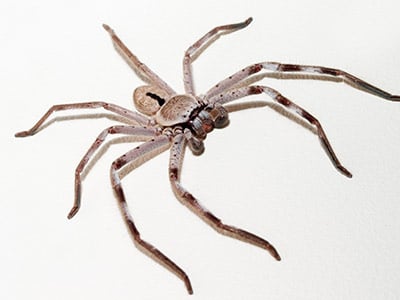
Huntsman spider (Sparassidae family)
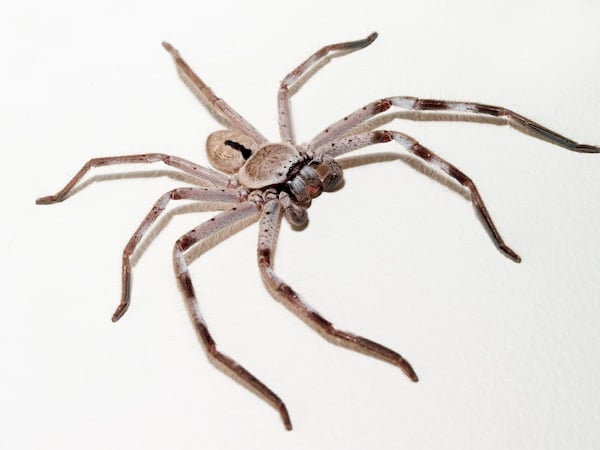
Pest Snapshot - Huntsman Spider
- Scientific name: Sparassidae family.
- Identification: Over 100 species in Australia. Large, fast running spiders with a flattened body. All have long, legs relative to body size, which are forward bending (crab-like appearance).
- Health threat: Low
- Bite pain: Mild
- First aid: Standard spider bite first aid.
- Web description: Do not produce webs.
- Where do they live? Under bark and rocks.
- Main pest season: Spring to Autumn in temperate regions, year round in the tropics.
- Indoor/Outdoor pest: Indoors
- Difficulty to control: Quite difficult
Huntsman Spider Information
Other common names
There are a number of species of huntsman spiders, many have a common name. A generic common name that is sometimes used is the giant crab spider. They are sometimes called tarantulas due to their size, but this is incorrect.
Identification
There are a range of species generally black, grey or brown in colour, but often with some striking patterns. The sizes of the different species is also variable – although their bodies rarely exceed 2 cm long, the leg span of the largest Australian species can exceed 15 cm!
Apart from the flattened body in some species, all have a crab-like arrangement to their legs. Their joints are twisted so their legs can spread out laterally and to the front (which also aids squeezing into small spaces).
Huntsman spiders have eight eyes, set in two rows of four.
There is also a social huntsman species (Delena cancerides), which lives in groups of up to 200 hundred, with a single dominant female.
Do huntsman spiders make webs?
Huntsman spiders do not build webs – they are considered a ground, running or hunting spider.
They do use their silk to make egg sacs.
Life-cycle
Mating:
The mating ritual of huntsman involves a lengthy courtship process which includes mutual caressing. Unlike in many other spider species, the male is rarely attacked during the courtship process.
Eggs:
The various huntsman species lay their eggs flat, oval egg sacs, containing up to 200 eggs. In many species the egg case will be placed under bark or rock, which the female will guard until they are ready to hatch. Some species will carry the egg sac under their body.
Huntsman baby spiders:
It will take several weeks for the eggs to hatch (depending on temperature). In some species the female spider will moisten and tear open the egg sac. The young huntsman spiderlings are pale and it takes several moults for their colour to darken. They will stay with the mother for several weeks / moults, before dispersing.
Life-span:
Huntsman spiders can live for 2 years or more.
Where are huntsman spiders found?
Huntsman spiders are found throughout Australian and globally in most warm temperate / tropical regions.
There nearly a 100 different species of huntsman spider in Australia.
Their natural habitat is underneath bark and rocks. Many species have very flattened bodies to allow them to squeeze into the tightest of spaces (think into a car, under the back door, etc!).
What do huntsman spider eat?
Huntsman spiders will eat insects, other arthropods, small lizards and frogs.
Huntsman themselves have a number of predators including some predatory wasps, which will paralyse the huntsman and take it back to their nest to use a live food for their larvae when they hatch.
Prevention tips:
Huntsman spiders are very much part of Australian life. Having less vegetation around the perimeter of the building will reduce the chances of a huntsman getting in. Having well fitted doors and windows (they need to be very well fitting), will also help.
Huntsman are generally considered as beneficial, in that they target other pests around the home including cockroaches.
It’s always a good idea to keep clothes off the ground and check the bed sheets in summer – huntsman will often come inside to escape the heat and squeezing under clothes and sheets is just like squeezing under bark… they feel quite at home!
Other species of spiders.
Huntsman Spider Bite Information
What does a huntsman spider bite look like?
The huntsman bite general appears as the classic double puncture wound seen with many spider bites. The bite site will then develop redness and a small amount of swellng.
Symptoms
Although huntsman may look scary, they are actually quite timid and will generally run way rather than bite. The exception can be females who are guarding an egg sac, who may get more aggressive.
Symptoms:
- The huntsman bite causes localised pain and swelling.
- Occasionally mild nausea and headaches.
Treatment
The recommended treatment for huntsman spider bite is to carry out spider bite first aid, supplemented with pain killers.
First Aid:
- Keep the victim still (sit down or lie down)
- Apply an ice pack to the bite area
- (Capture or take a photo of the spider for identification)
- Seek medical attention
- if the victim is young, elderly or infirm
- if pain is severe
- if victim has a severe reaction (anaphylactic shock or collapse)
Medical disclaimer: The information provided on this website is for educational purposes only and does not substitute for professional medical advice. If in doubt about identifying the spider or understanding the required first aid, seek medical attention immediately. ff the victim experiences a significant reaction to the bite (no matter which spider), seek medical help immediately.
In case of emergency call 000. If uncertain about what to do call the Poisons Information Line 13 11 26.
How to get rid of huntsman spiders?
The general strategy to keep huntsman spider numbers down around a property is to carry out a general pest treatment to eliminate potential prey for the huntsman. A professional pest control treatment is likely to deliver the best results due to the products they use and the ability to apply a comprehensive treatment, along with their knowledge of potential hiding spots.
It is unlikely any treatment can 100% guarantee to keep huntsman out of the house as they can squeeze through the smallest of gaps and tend to walk on the tips of their legs, both actions that will limit their contact with any treated surface.
Keeping vegetation away from the perimeter of the building and ensuring tight fitting windows and doors also help.
Huntsman Spider FAQ
Do huntsman spiders bite?
Yes, huntsman can and do bite… but not very often. Despite their scary appearance, they are actually quite timid and will generally run away rather than bite. The possible exception are female spiders who can get quite aggressive when protecting their egg sacs.
Are huntsman spiders venomous?
Are huntsman venomous? Not really, their bite only causes a mild reaction in humans.
Do huntsman spiders jump?
Huntsman can certainly move very fast but they can’t really jump. To escape a threat (and sometimes when hunting) huntsman spiders can fall off vertical surfaces and ceilings. If the fall occurs whilst running fast, it can certainly appear that they are jumping. This is even more the case, if they “fall” in your direction!
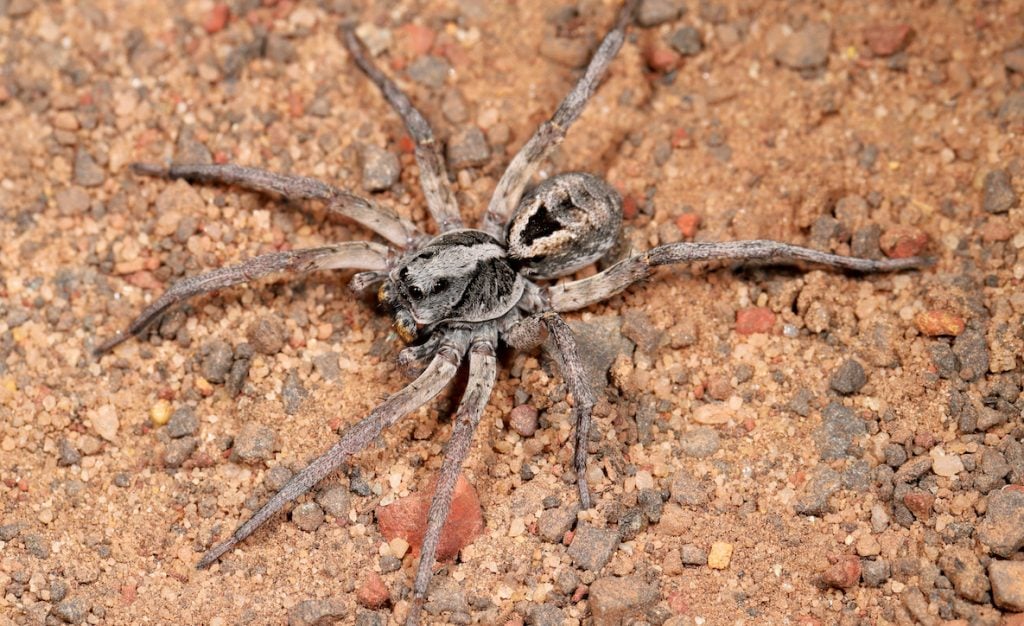
Huntsman spider v wolf spider
Sometimes huntsman and wolf spiders can be confused, especially to the untrained eye. Both are fast moving hunting spiders, with often similar colouration. However, there are a few difference that can be used to tell them apart:
- Both spiders have 8 eyes, but huntsman have eyes in 2 rows of 4, whereas wolf spiders have their eyes in a 4+2+2 arrangement.
- Although huntsman will hunt both above ground as well as on the ground, wolf spiders tend to hunt exclusively on the ground surface.
- Wolf spiders will building burrows in the ground.
- Huntsman legs are forward pointing, giving it a crab-like appearance.
- Huntsman are generally the bigger spider when fully grown.