
Daddy-long-legs spider (Pholcus phalangioides)
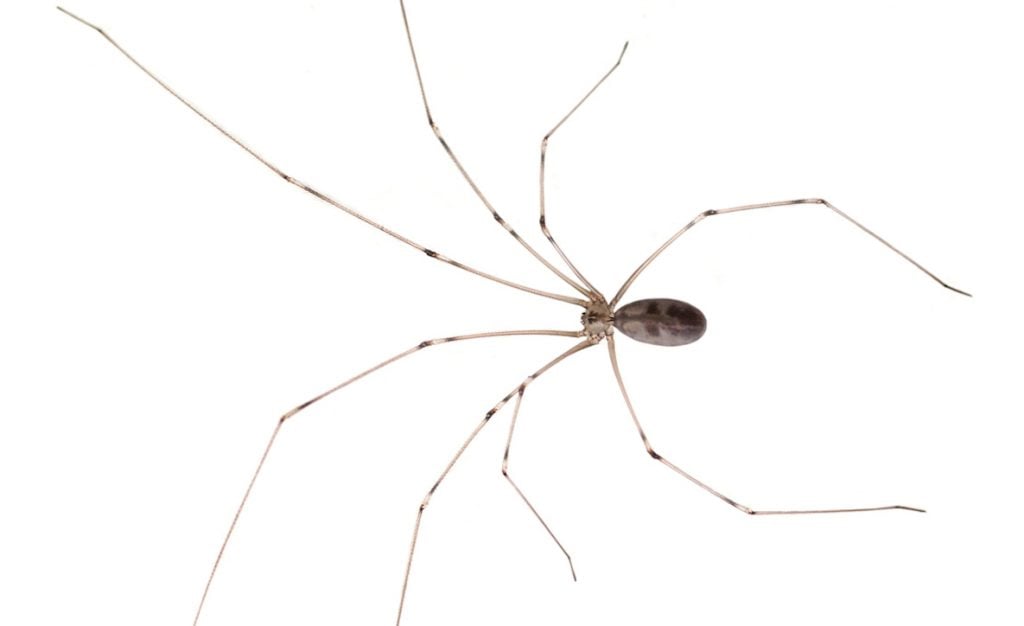
Pest Snapshot - Daddy Long Legs Spider
- Scientific name: Pholcus phalangiodes is the most common spiders, but there are a number of species
- Identification: Daddy-long-legs have a body length of around 9 mm, but their legs can be up to 50 mm long and vary in colour from beige to pale brown.
- Health threat: Low
- Bite pain: Mild
- First aid: Standard spider bite first aid. Seek medical attention if victim has a severe reaction.
- Web description: Messy irregular webs. Not sticky.
- Web locations: In undisturbed rooms and areas of buildings. In particular garages, sub-floors and basesments.
- Main pest season: Year round
- Indoor/Outdoor pest: Indoors
- Difficulty to control: Easy
Daddy Long Legs Spider Information
Other common names
Also called cellar spider, vibrating spider or gyrating spider
Identification
Daddy-long-legs have a body length of around 9 mm, but their legs can be up to 50 mm long. They can vary in colour from beige to pale brown.
Not to be confused with harvestman “spiders”, which are also called daddy-long-legs but are of the order Opiliones. Harvestman are not actually spiders but are more closely related to scorpions and are identified by having the appearance of a single body segment (actually the two body segments are fused together) and a single pair of eyes.
Daddy long leg spiders web
Daddy long legs webs are messy and irregular. They are not sticky, with the spider reliant on speed to capture any prey that enters the web.
They exhibit a strange behaviour when disturbed – gyrating rapidly and vibrating the web. This is the reason they are sometimes called gyrating or vibrating spiders.
Life-cycle
Mating:
The male spider generally tries to mate with the larger females. Mating may take several hours.
Eggs:
After laying her eggs, the female wraps them in a silk package, which she carries under her body until they hatch.
Daddy-long-legs baby spiders:
The female spider looks after the baby spiders or spiderlings for around nine days after hatching – until after the first moult. At that point the spiderlings leave the maternal web.
Life-span:
Daddy-long-legs spiders live for about three years.
Where are daddy long legs spiders found?
Daddy long legs are a common “house spider”, setting up their webs in the corners of rooms and under furniture – any sheltered positions. They are sometimes called cellar spiders as they are often found in basements and sub-floors.
They are thought to have originated in Europe but are now found in all continents apart from Antarctica.
What do daddy long leg spiders eat?
Daddy long legs spiders eat a wide range of other insects, including other spiders such as the redback and huntsman. It is for this reason, that it became the general belief that daddy long legs had a more toxic bite than the redback. However, this is a myth.
Some species also vibrate the web of prey spiders to mimick trapped prey, to draw them out of their hiding place.
Prevention tips:
Regular cleaning and vacuuming will prevent daddy-long-legs setting up home.
Information on other spider species.
Daddy Long Legs Bite Information
Symptoms
Not only is there the common belief that daddy long legs bite is amongst the most toxic of spider bites, there is also the belief that the reason humans are not at danger from a daddy long legs bite is because their fangs cannot penetrate human skin. Both are myths!
In fact a segment on the US Mythbusters television show demonstrated that the 0.25 mm fangs could indeed penetrate human skin, but that the resulting reaction, a mild stinging sensation, was very short lived.
Symptoms:
- Mild, short-live stinging sensation. Not considered harmful to humans.
Treatment
First aid:
- Apply an ice pack to the bite area
- (Capture or take a photo of the spider for identification)
- Seek medical attention if the victim has a severe allergic reactions or if symptoms persist
Medical disclaimer: The information provided on this website is for educational purposes only and does not substitute for professional medical advice. If in doubt about identifying the spider or understanding the required first aid, seek medical attention immediately. ff the victim experiences a significant reaction to the bite (no matter which spider), seek medical help immediately.
In case of emergency call 000. If uncertain about what to do call the Poisons Information Line 13 11 26.
How to get rid of daddy-long-legs spiders
A professional pest manager can provide a professional spider treatment that will include daddy-long-legs. The treatment will kill any spiders present and indeed a surface spray will prevent daddy-long-legs from building their webs.
However, homeowners can easily eliminate the occasional daddy long legs with a quality crawling insect spray.
For a non-chemical option, daddy-long-legs and their webs can easily be removed by vacuuming.
Daddy Long Legs FAQ
Are daddy long legs venomous?
No daddy long legs are not particularly venomous. Even though they will target other spiders as prey, including spiders which are more venomous to humans (such as the redback), they venom is only mildly toxic to humans.
Are daddy long legs spiders?
Yes, daddy long legs are spiders… at least if you’re referring to spiders in the Pholcidae family.
However, the name daddy long legs is given to a number of spiders and opili0nes (harvestman), which are arachnids but not spiders.
Can daddy long legs spiders bite?
Yes, despite daddy long leg spiders can bite humans. However, they are a very timid spider and bites are unlikely. Their venom is only mildly toxic to humans as so the bite feels like a mild sting (short-lived).