
The yellow-legged hornet continues to pose a threat in Auckland, with biosecurity measures escalating.
Biosecurity New Zealand has announced a step forward in the battle against the invasive yellow-legged hornet, which has been found in various locations across north Auckland.
Since October last year, 60 queen hornets have been found in the Glenfield and Birkdale areas on Auckland’s North Shore. The pest, not known to be established in New Zealand, was considered a biosecurity concern due to the potential impact on honeybee and wild bee populations.
Using technology from the Netherlands, biosecurity commissioner Mike Inglis said they had been luring workers to feeding stations and attaching small radio transmitters to them to observe their movements.
“Tiny transmitters weighing less than 160 mg are attached to the workers, and we’ve been able to track their flight path back to the nests using signals from the transmitter to a radio receiver.
“Once we have a transmitter attached to a hornet, we are typically locating the nest within a few hours.”
He said they were also using thermal drones to pinpoint the location of the nests and to determine the size of the population inside. He said the technology had helped find hundreds of workers and nests, bringing the total number of nests discovered to 72.
“We’ve been able to destroy the nests with any queens and workers inside them. So far it’s been very successful.
“Our focus is on locating and destroying queens to stop them from producing any new generations.
“It’s really important as we go through the summer, and more workers build secondary nests sometimes in higher up trees, that we continue to use these trackers alongside thermal drones, so we can locate these nests and destroy them, and hopefully the queen is in that secondary nest.”
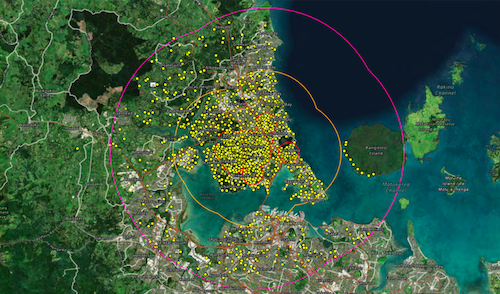
Alongside the tracking technology, a network of more than 1,080 traps is in place. The zones reflect the density of traps and there have been no detections outside the 11 km area.
So far, between $2m and $3m has been spent on the hornet eradication operation. Around 170 staff have been involved, with a variety of entomologists, communications staff and contractors working together.
“It’s a heavy investment, but it’s absolutely worth it to make sure we’re on top of this and we eradicate the hornet,” added Mr Inglis.