With the European wasp posing a growing threat in Australia, researchers are investigating the feasibility of bio-control measures.
The European wasp is an established invasive pest in Australia that is not only a safety concern in urban areas but has an impact on agriculture, tourism, social activities and local wildlife. Invasive pests often quickly establish and become a problem as they have no natural predators or diseases in the new environments to keep their populations in check. Researchers are looking at options to see whether biocontrol of the German (European) wasp, Vespula germanica, in Australia is both technically and economically feasible.
In its native range, the European wasp is affected by a parasitoid wasp, Sphecophaga vesparum (shown above). Use of the parasitoid to control the European wasp in the 1980s in New Zealand was unsuccessful. Populations of the parasitoid failed to become established, with the failure blamed on the fact that all the parasitoids released lacked genetic variety because they were derived from a single female. Some of the same wasps were approved for release in Australia, but with poor post-release monitoring, no evidence of the establishment of parasitoid populations was documented.
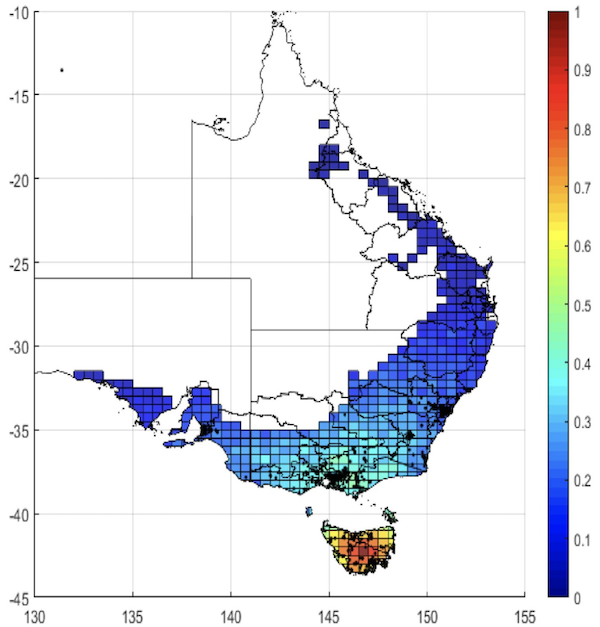
Researchers have decided to look at the potential for bio-control differently. Instead of carrying out a release trial and assessing performance, scientists have carried out a modelling exercise to establish the conditions required to make a bio-control program successful.
The modelling assessed the impact of four different levels of bio-control efficacy on European wasp populations and then converted this reduction in wasp population to a dollar value benefit – the reduction in damage assessed against a range of metrics.
Initially modelling indicated that the potential savings in reduced damage ranged from AU$14-95 million for the different scenarios, with an additional AU$20-70 million saved in reduced treatment costs by homeowners, pest managers and authorities. However, more in-depth sensitivity modelling varying the factors impacting performance suggested that savings due to reduced damage could well be in the range of AU$145-385 million, with an additional 50% saved on reduced treatments.
With the estimated cost to deliver a bio-control program estimated at between AU$2.9-8.8 million, the researchers therefore conclude that government funds should be made available to assess whether such a program can actually deliver in practice.
They identify two key areas of research for these real-world trials, with the aim of answering the following questions: firstly, does the bio-control program actually achieve the performance assumed in the modelling, in the real world? Secondly, does the parasitoid wasp become established where inoculated in the environment, and does it spread to other areas where the European wasp is present? This would be the focus of initial field trials.
From an environmental point of view, Sphecophaga vesparum only parasitises Vespinae wasps and as Australia has no Vespinae wasps, the risk to native wasp populations is considered low.
Further reading: Hester, M.H et al. (2024). Biological control of the invasive wasp Vespula germanica in Australia: Assessing socio-economic feasibility. Ecological Economics, 224. https://doi.org/10.1016/j.ecolecon.2024.108315
Main image credit: The parasitoid wasp, Sphecophaga vesparum, by Nils-Uno Svensson/iNaturalist CC by NC 4.0