Insect growth regulators are incredibly effective at interrupting insect life cycles, provided pest managers know how and when to use them.
Insect growth regulators (IGRs) are a valuable and often underutilised tool for pest managers. Part of the reason for this lack of use stems from the confusion as to how IGRs actually work. In turn, without this knowledge, some pest managers are unsure when to use them. Here we try to de-mystify IGRs.
Before discussing how IGRs work, it’s important to understand the insect moulting process. Juvenile hormone is present in all insect larval stages, with rising levels of the hormone ecdysone required to initiate the moulting process at each stage. It is the combination of juvenile hormone and ecdysone that is required to moult. Juvenile hormone drops off in the final instar to allow pupation and is absent in the adult stage. Chitin is the key structural carbohydrate found in the insect exoskeleton and so the production of chitin is required to form the new cuticle for each moult. The image above shows a cockroach moulting from final instar to adult.
IGRs can be classified under one of four modes of action, depending on the stage of the moulting process they impact:
- Juvenile hormone mimics (JHMs): Prevent pupation (for insects with complete metamorphosis, like the flea) or moulting to the adult stage (for insects with incomplete metamorphosis, like the cockroach)
- Ecdysone agonists: Mimic ecdysone and force insects to moult before they are ready
- Ecdysone antagonists: Inhibit the effect of ecdysone and prevent moulting
- Chitin synthesis inhibitors (CSIs): Prevent production of chitin and therefore impact the production of new cuticles.
Most of the IGRs, and certainly the majority used in urban pest control, are either CSIs or JHMs. Whilst both types of IGRs are used in products targeting cockroaches and fleas, CSIs are also used in products targeting termites and silverfish, with JHMs used in products targeting mosquitoes and ants. Broadly speaking, CSIs have a bigger impact on the moulting process of insects, but JHMs have a bigger impact on a broader range of development processes, particularly on insects with a complete metamorphosis.
CSIs kill insects when they try to moult – the lack of chitin means they are unable to produce a new cuticle. They also deliver a level of egg kill, by interfering with the normal development of the embryo.
JHMs kill insects with a complete metamorphosis (e.g. fleas) at the pupal stage and although they don’t always kill insects with an incomplete metamorphosis (e.g. cockroaches), the adults that do survive are sterile and often deformed. Insects can be particularly sensitive to JHMs at very low concentrations and they can even impact the adult stage – for example, female cockroaches will drop egg cases, which don’t develop.
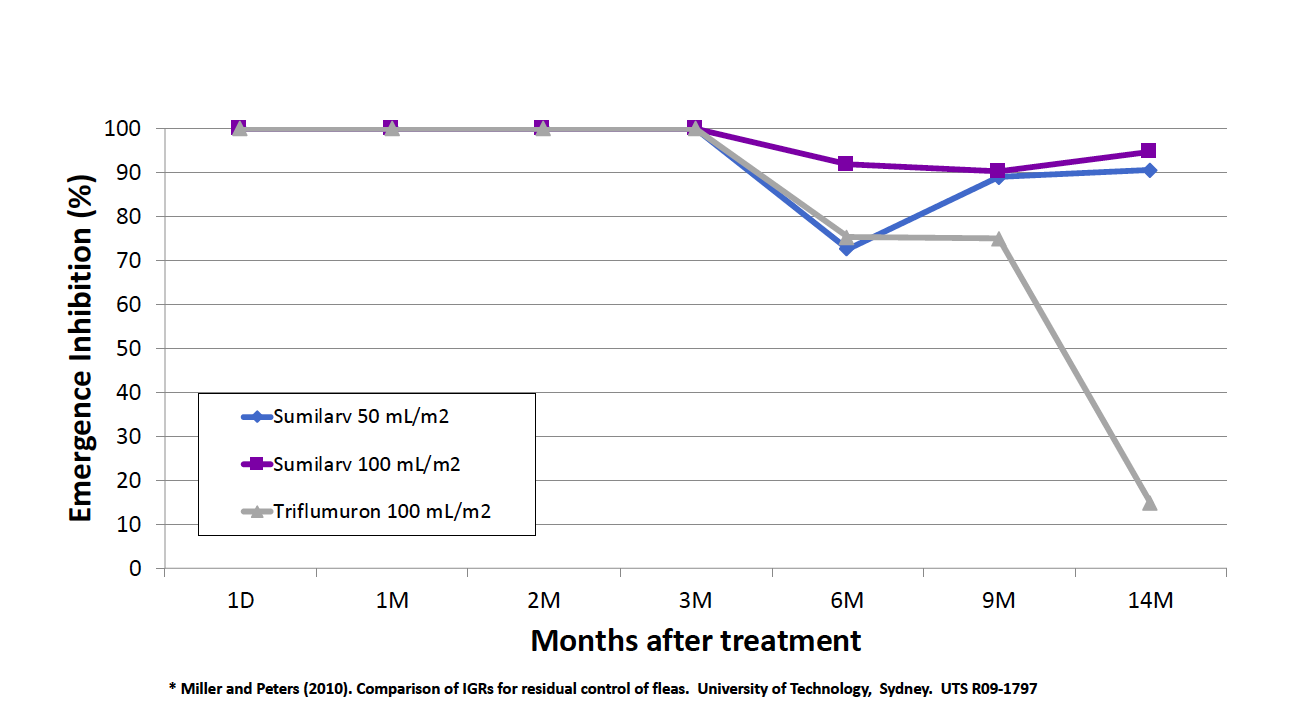
Pyriproxyfen (Sumilarv) is one of the most well studied JHMs. Research has demonstrated that it works on all life stages of the flea, and actually kills the larvae. Indeed, the lethal concentration to kill flea larvae is some 5-6 times lower than fipronil. Being active at such low concentrations and very stable allows Sumilarv to provide long residual performance, as demonstrated by the trial recording a 90% reduction in flea egg hatch, for a year or more on carpet (Figure 1).
IGRs like Sumilarv should be used as standard, in tank mixes with a suitable insecticide, for cockroach and flea treatments. As a non-repellent chemical, it does not impact the behaviour of the insects. Importantly, its enduring residual activity ensures long-lasting performance, which is highly desirable for cockroach treatments (especially in commercial accounts) and flea treatments.
IGRs are also particularly useful in bait formulations, with the whole product concept of termite baits based on CSIs. IGRs are sometimes also used as part of an active mix in cockroach and ant bait formulations. Synergy Pro uses a combination of hydramethylnon and pyriproxyfen, with the activity of pyriproxyfen at very low levels effectively sterilising the queen, even if she doesn’t ingest a lethal dose of hydramethylnon.
Mosquito control has also benefited from IGR use, as JHMs are highly effective at controlling mosquito larvae. Sumilarv Granular and Sachet formats provide pest managers with an important tool in mosquito management programs.
With their very low toxicity to mammals and birds, IGRs are ideal for sensitive accounts and can be used on their own as a preventative treatment. Sumilarv as a standalone spray for cockroaches and fleas, and Distance Plus for ants, provides pest managers with effective solutions when use of other products is restricted.
IGRs really are smart actives that target specific insect development pathways. Knowing when to use them not only delivers performance benefits but can demonstrate your expertise in discussions with clients.