Researchers from India and Australia outline the case for biocontrol measures against mosquitoes carrying the dengue fever virus.
In August 2025 the World Health Organisation stated the facts about dengue fever: half of the world’s population is now at risk of dengue, with an estimated 100-400 million infections occurring each year. In the absence of effective antivirals or a universal vaccine, vector control remains the key to reducing the incidence of dengue fever.
For Aedes aegypti, traditional mosquito control programs have focused on eliminating breeding sites (small containers). These are supplemented by chemical applications – space spraying, residual surface sprays and the use of insect growth regulators. However, achieving a significant reduction in mosquito numbers, and therefore a reduction in dengue transmission, has been challenging.
Rather than targeting the mosquito itself, for many years scientists have also been focusing on ways to eliminate the dengue virus that they carry. The most promising approach has been to utilise the Wolbachia bacteria. Successful laboratory studies have led to field trials and incorporation into control programs. But how effective is this novel biocontrol method for reducing dengue?
How it works
Wolbachia is a naturally occurring bacteria found in many insects, including many species of mosquitoes, although it is not normally carried in Aedes aegypti. Researchers discovered that Wolbachia blocks the replication of viruses such as dengue, chikungunya and Zika inside Aedes aegypti mosquitoes. This means that mosquitoes infected with Wolbachia have a reduced ability to transmit viruses to people.
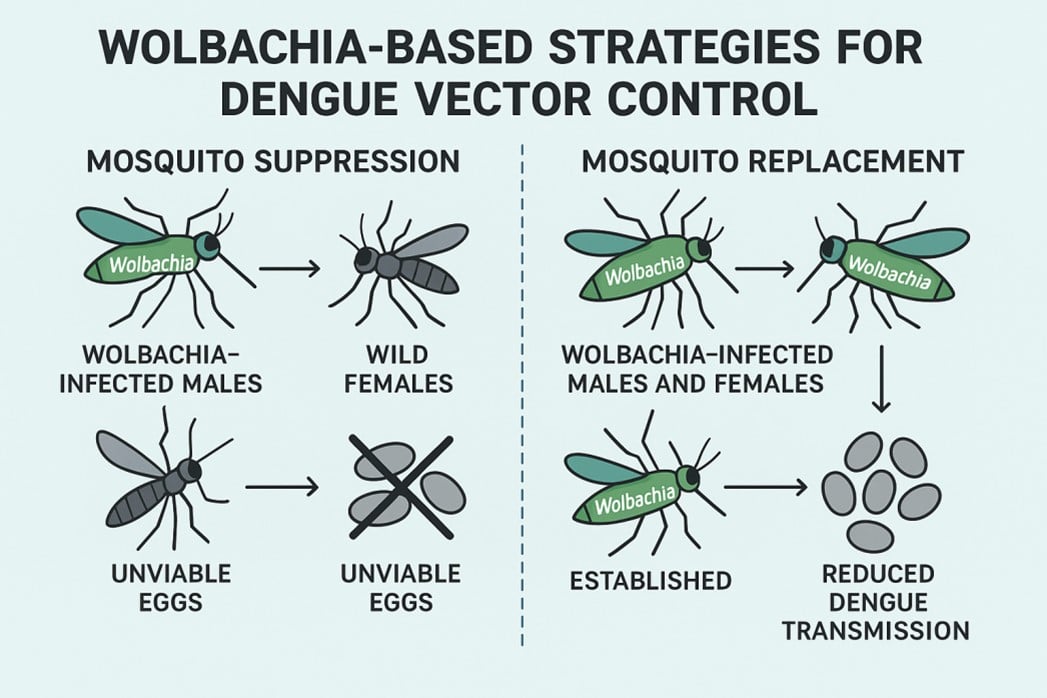
Scientists have used Wolbachia to take two approaches to mosquito control: population suppression and population replacement (Figure 1). Population suppression is an approach where Wolbachia-infected male mosquitoes are released into the wild to mate with females. When Wolbachia-infected males mate with Wolbachia-free females, the resulting eggs are unviable due to cytoplasmic incompatibility between sperm and egg, and they do not hatch. As a result, the population is therefore suppressed. The reduction in mosquito numbers results in reduced dengue transmission.
This approach requires repeated mass releases for continued impact, as well as genetic compatibility between the released and local mosquitoes.
Population replacement is the second approach. Here, both infected males and females are released. In this case, viable eggs are produced as the sperm and egg are compatible. Although this does not reduce the mosquito population, it does allow the Wolbachia to spread through the population, which blocks the replication of the dengue virus, reducing dengue transmission. Once Wolbachia-infected populations are established, the Wolbachia infection levels can persist in the population without further intervention. While a greater number of mosquitoes are required for initial male and female release, the effect is potentially self-sustaining.
Case study: Australia
Mosquitoes infected with Wolbachia were first released in northern Queensland in 2011, taking a population replacement approach. Prior to the release of Wolbachia mosquitoes, there were annual dengue outbreaks, initiated by infected travellers returning from overseas. Local Aedes aegypti populations then became infected and spread the dengue virus.
After the initial release of Wolbachia mosquitoes, phased releases in northern Queensland led to a dramatic reduction in dengue outbreaks. Long-term monitoring shows that Wolbachia has become self-sustaining at high levels in the mosquito population for over a decade, without additional releases of Wolbachia mosquitoes.
In areas where high levels of Wolbachia are present, there has been no evidence of local dengue transmission, despite an uptick in reported dengue cases across the region since the reopening of borders post-Covid (2022). Wolbachia levels in the local mosquito populations across Townsville, Charters Towers, Douglas Shire, Cairns and the Cassowary Coast continued to be monitored.
The success of this project, driven by the World Mosquito Program (WMP), came down to meticulous planning, strong community engagement, and long-term surveillance. Other projects managed by the WMP have proven the success of the method. Results from other population replacement programs in Indonesia and Brazil have also shown that it works.
The population replacement approach has proven to be well suited for long-term, sustainable reduction where stable Wolbachia establishment is feasible. Replacing a wild population with a dengue-free, lab-reared population offers lasting benefits by stably reducing both mosquito longevity and vector competence.
Challenges
Success largely depends on the fitness of the lab-reared mosquitoes that are released. They must survive, disperse, mate, and reproduce effectively to establish Wolbachia in wild populations. Yet, lab-reared mosquitoes often suffer fitness deficits – reduced survival, reproductive ability, or altered behaviour – due to artificial rearing conditions. In addition, environmental factors, such as temperature, humidity and rainfall significantly impact Wolbachia density and dengue transmission.
Cautionary evidence: Vietnam and Thailand
In contrast to the notable successes in Australia, Indonesia and Brazil, Wolbachia deployments in Vietnam and Thailand have revealed key operational and ecological limitations. In Nha Trang, Vietnam, the establishment of infected Aedes aegypti was inconsistent, with Wolbachia prevalence fluctuating across seasons and neighbourhoods, leading to negligible impact on dengue numbers. Similarly, Thailand’s hybrid strategy – merging population replacement and suppression – struggled to maintain stable Wolbachia presence due to multiple entomological and ecological stressors.
The mosquitoes in these cases suffered diminished fitness, meaning reduced survival rates, delayed larval development, and low-level mating competitiveness between males. The high ambient temperatures in the region also had a significant negative impact on Wolbachia density and transmission.
Is Wolbachia the best solution?
The success of Wolbachia-led biocontrol programs is not universally transferable. In order to be successful, they demand precise execution, resident support, the use of fit mosquito strains and thoughtful integration with existing vector control measures. The mixed outcomes from Vietnam and Thailand emphasize that the local environment is a critical factor for consideration.
But while biocontrol measures face hurdles – not to mention those of a social, regulatory, and financial nature – Wolbachia-based dengue control has undoubtedly redefined the landscape of vector-borne disease management, offering an innovative, eco-sustainable, and scalable biological intervention.
In fact, a major project, Driving Down Dengue, is currently underway in the Laos capital Vientiane, where more than 130 million bacteria-infected mosquitoes are being released. The Wolbachia-infected mosquitoes are bred in Melbourne, where the eggs are then dried, packaged in pills and shipped to Laos. Once in Laos, the eggs are reared to larvae in a lab, and then reared inside paper cups that are sent around the country to allow the Wolbachia-infected mosquitoes to make their way into local populations.
At the heart of the uncertainty of Wolbachia biocontrol measures lies an incomplete understanding of the precise mechanisms by which Wolbachia suppresses dengue virus replication – a knowledge gap that makes it challenging to predict long-term efficacy and viral evolutionary responses to the biocontrol measures we are taking today. For example, there is still the potential for Wolbachia-infected mosquitoes to mechanically transfer the dengue virus, where the virus on the mouthparts of the mosquito get transferred between humans during multiple probing/feeding events.
As it stands, the objective of the WMP is now to rapidly increase production of Wolbachia-carrying mosquitoes and to deploy them in tropical populations where dengue presents the greatest risk to human health. Taking a biocontrol approach seems to be the most promising avenue for mitigating dengue fever globally.
Article authors:
Dr N Sivagnaname, Rtd, ICMR-Vector Control Research Centre, Puducherry, India
Dr S Yuvarajan, Sri Mankula Vinayagar Medical College, Puducherry, India
Dr Raja Mahendran, International Pest Business Consultant, Australia.
Article submitted to Professional Pest Manager magazine by Dr Raja Mahendran, international pest business consultant in Sydney, Australia. His passion is for pest risk management as a sustainable future of pest control.