Sophie Thorogood, Technical Training Manager at Pelsis, outlines tips for identification and treatment for small nuisance flies.
Flies pose a continuous threat to food establishments including restaurants, cafes, food manufacturing facilities and commercial kitchens due to their high prevalence and quick breeding cycles. Once inside a foodhandling establishment they can contaminate food with their bodies and be vectors of foodborne pathogens such as Salmonella and E. coli. But as pest managers know, not all flies behave the same way.
The fly order, Diptera, is extremely diverse, containing an estimated 150,000 described species. Most species occupy very specific ecological niches, and understanding their individual biology is essential for designing effective control and treatment strategies.
Here I’ll outline the most common small flies to be well informed about.
People often use the description, “fruit flies” (Drosophila spp.) as a blanket species identification for most small flies, as it’s the one they are most familiar with. But let’s be clear: our typical fruit fly (Drosophila) is better described as a vinegar fly. This is because while the fruit bowl is a common location we find these flies breeding in, it is the fermenting fruit they are feeding on, specifically the yeasts growing there. This means Drosophila spp. can be found on anything fermenting including milk, vegetables, syrups, beer and other alcohols, and even faecal material.
Drosophila melanogaster, our most famous species, has bright red eyes and a lighter body than other species. Typically, all the species are 3-4 mm long, with wings held over the back and short legs relative to the body compared to other species.
Another group of small flies to consider are the phorid flies (Phoridae). Also described as coffin flies, scuttle flies or humpbacked flies, they are a similar size (3-6mm), similar coloured (from light brown to darker brown) and can be found around decaying matter and in similar environments as vinegar flies. However, phorid flies are more associated with slow-flowing or dirty drains, and decaying animal and plant matter.
Figure 1 is one of my favourite photos, showing the wing difference between vinegar flies and phorid flies. While blurry at first, when under a microscope the wing venation becomes clearer and differences can be detected.

Phorid flies (Figure 2) also have a humped back and long, strong back legs. They are often confused with the darker eyed Drosophila species, but when they are on their side, it is clear to see the humped back.
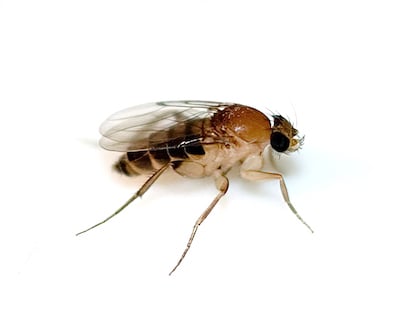
While we are on the topic of humped backs, we also must talk about the fungus gnats (Sciaridae). There is great diversity in size within this group (2-10 mm), but they typically all have a humped back and a Y-shape in their wing venation (Figure 3).
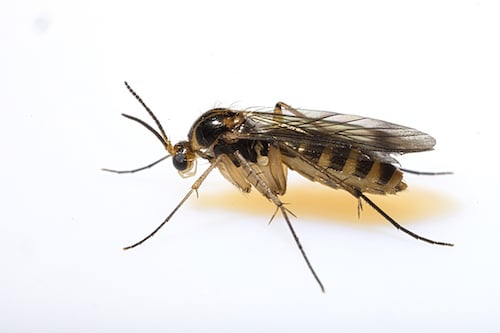
They can be different colours but usually they are brown to dark brown in colour. Often people mistake them with mosquitoes, but mosquitoes will be larger, more slender and have longer antennae.
Fungus gnats will be found in greenhouses, homes with plants, and mushroom or lettuce farms – places where there is plant life and a high moisture content of the soil. Too much watering will lead to the soil having mould growth and the plant roots decaying, which will provide a food source for fungus gnats.
It’s a good idea to pay close attention to small flies in your accounts. Insect light traps (ILTs) with glue boards are very useful – they make counting the flies easy and quick and allow for easy identification (remember to look at the wings, as each species has a unique wing structure). Electrocuting grids make it almost impossible to accurately identify small flies and therefore glue boards are both better for monitoring and more hygienic as there is a risk of insect fragmentation.
Flying insects are highly attracted to ultraviolet light (UV-A) which is used in all ILTs either by traditional fluorescent lamps or energy saving LEDs. Humans are unable to see UV light and so a common misconception is that the brighter the ILT, the more attractive it will be to the insect. However, the more light humans visibly see from the unit is more wasted light coming from the unit. To make the ILT perform optimally, it should be sited away from competing light sources, such as windows, doors and overhead lights. The best location would be the darkest spot in the room, where the ILT would shine the brightest. Additionally, it would be poor practice to have the ILT facing an external door that is often opened. This is because the light can encourage insects to come into the site and thereby increase the number of insects and increase the fly risk to site.
Lastly, try not to place ILTs in places it is hard to service them, such as too high, above doorways or above food preparation areas as this would increase the risk to food by flies moving over the surface to get to the ILT.
Pelsis is a global manufacturer of ILTs, offering a wide range of products to meet different customer needs. The Infiniti range was one of the first LED ILTs developed and comes in four versions for either traditional settings (Infiniti 2), front of house (Infiniti Compact), wet environments (Infiniti Aqua) or large warehouses (Infiniti 4).
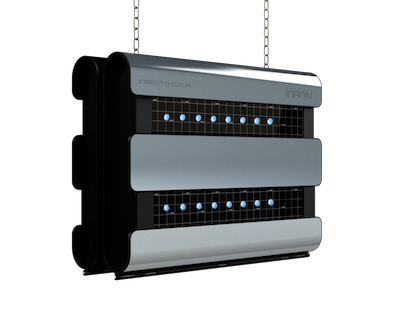
Pelsis has also developed the award-winning digital range that uses AI (Halo Digital) to count the number of insects caught on the glueboard.
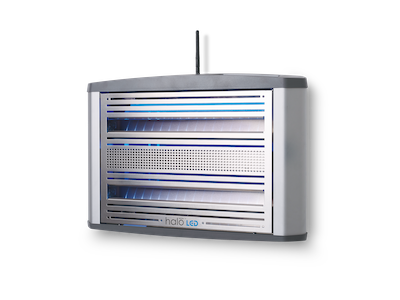
This system counts the number of insects caught up to every 15 minutes allowing early detection of infestations. The system will send notifications if there is a sudden increase in the number of insects caught or if a particular threshold has been met, highlighting that there is a pest issue to solve.
Sophie Thorogood, Technical Training Manager, Pelsis