An account of the world’s largest drone-based ant eradication operation, conducted here in Australia in November 2017.
Invasive ants cost the global economy more than $6 billion annually. As a result, Australia’s biosecurity has a clear focus on preventing new ant incursions and developing the most effective methods of treatment.
There are now more than a dozen exotic ant species established within Australia. Some of these species that are only recent arrivals – such as the browsing ant and electric ant – we have a high chance of eradicating from the country, but other species that have been here for a long time and are very widespread, such as the African big-headed ant, we can only eradicate from isolated locations, such as islands and national parks. There are currently more than a dozen eradication or management programs in Australia that will cost more than $400 million over the next 10 years. Globally, there have been more than 144 successful site-level ant eradications completed, so it is a real option. Eradication efforts are definitely becoming more successful as techniques and technology develop.
Multiple bait dispersal methods are used for ant eradications. Treatments by hand-dispersal, including the use of motorised blowers, is limited to small and accessible areas. Aerial dispersal is now routine, with helicopters being used for larger areas. But the use of helicopters is limited in remote locations due to the high cost of transport, especially for oceanic islands. Drones may be a solution to the dispersal limitations encountered in some situations, but until now the capacity for drones to deliver large quantities of bait over substantial areas has been extremely limited.
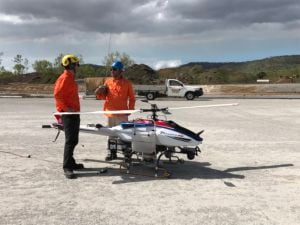
In November 2017, Australia conducted the world’s largest drone treatment for ant eradication using the country’s largest non-military drone, The Fazer. This specific drone is a petrol-powered autonomous drone currently being used in precision agriculture in Australia. Most drones are too small with short battery-restricted flight time to be considered viable for this work because only small loads (less than 10kg) can be carried. But this drone can fly for 90 minutes non-stop and carry up to 40kg delivering a wide array of payloads from liquid sprays to large granules.

The work was conducted by Yamaha Sky Division and coordinated by CSIRO, in a yellow crazy ant eradication effort run by the Townsville City Council. The work involved a double treatment over approximately 50ha, first using Sumitomo’s granular bait (Synergy Pro Ant Bait), followed by an experimental bait consisting of water-absorbing hydrogels that had soaked up a solution of 30% sugar water containing 0.04g/kg fipronil. The baits were applied at 5kg/ha and 80kg/ha respectively.

The drone distributed the bait to clear specifications and the efficacy of the baiting was as successful as previous treatments conducted by helicopter or hand-dispersals in other eradication programs. Pre-treatment, yellow crazy ants were abundant but within a few days post-treatment, most individuals had been killed, in line with expectations. Because the drone flight was slow and computer controlled, flight paths were more precise than would normally be achieved by a manned helicopter operation. Bait flow was monitored live by a camera.
The use of the drone was highly successful and paves the way for further use within other eradication programs. It is envisaged that drone technology such as this will revolutionise our ability to conduct many eradication attempts, especially in remote locations with difficult terrain.
Dr Ben Hoffmann, Principal Research Scientist, CSIRO (NT)