House crickets are only an occasional pest – they are generally harmless, but will chew fabric and can make a very annoying noise! Here’s all you need to know…
House crickets maybe an occasional pest, but they can certainly be annoying – even the sound of one cricket calling in the night is enough to keep the household awake. But house crickets are more than just a sound annoyance, they can damage a wide range of fabrics as well. Here’s the essential information on house crickets and how to control them.
What are house crickets?
The house cricket, Acheta domesticus, is found worldwide and is a common cricket found across Australia. Gryllodes sigillatus, the tropical house cricket (also called Indian house cricket or banded cricket), is also present in Australia. Acheta domesticus adults are grey/brown and grow up to 2 cm long. Males and females can be identified by the presence of a long ovipositor in females. Gryllodes sigillatus is slightly smaller and a tan colour, with two thick black bands, one across the lower thorax and one across the upper abdomen. The house cricket should not be confused with the black field cricket, Teleogryllus commodus, the most common cricket found in Australian backyards, which is 2-4 cm long and dark black.
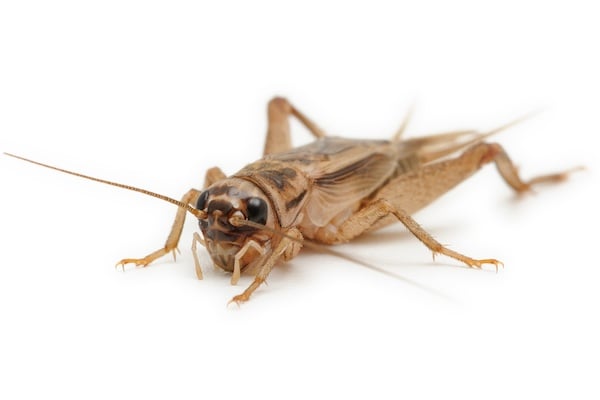
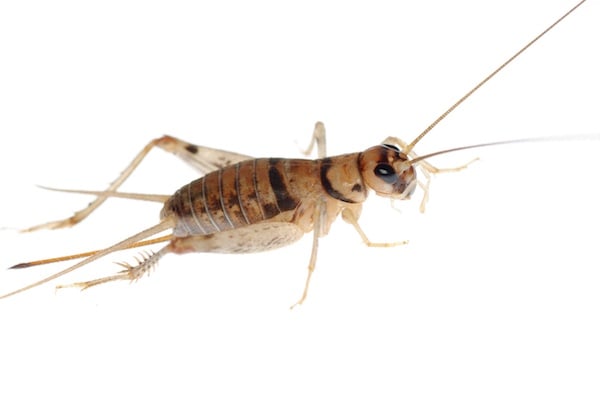
Both house crickets are of significant interest due to their use as mass-reared edible insects for the pet industry, but also more recently as a potential human food. Acheta domesticus is also used as a model insect species in research.
Acheta domesticus is particularly susceptible to cricket paralysis virus, which has decimated the cricket breeding industries in Europe and the US in the early 2000s. Gryllodes sigillatus appears to be more resistant to this virus.
House cricket life cycle
House crickets have an incomplete metamorphosis – the nymphs that hatch from the eggs are miniature versions of the adults (minus the wings) and go through 8-10 instars before moulting into an adult. The eggs are laid in any moist substrate in their environment and hatch within two weeks. They develop through 7-10 instar stages before moulting into adults. The whole life cycle can be completed in 2-3 months, with the adults living for about 1-2 months. During the cooler months, the life cycle slows down and survivorship is optimal in warm, moist locations such as dumps and compost heaps.
Key behaviours
House crickets typically live outdoors in garden beds, but also appear to be attracted to garbage dumps, due to the warmth, moisture and food. Crickets are omnivorous and will eat a wide range of plant and animal material, both dead and alive. Although house crickets are nocturnal, they are attracted to light. At night, the males make loud chirping noises by rubbing their front wings together, to attract females.
House crickets as pests
Although house crickets live primarily outdoors, they can find their way indoors when attracted to the lights of buildings. In colder and drier periods they may also come inside seeking warmth and moisture.
Homeowners may be aware of a house cricket infestation following the appearance of house crickets around the exterior building lights at night. Some of these crickets may well find their way inside the building and will try and find warm, moist locations to hide. As they are nocturnal and so not easily seen, homeowners are only likely to realise they have crickets in the house when they start to hear the males’ mating calls at night. This can be very annoying, and they can often be quite difficult to locate. While the noise can be annoying, house crickets can in fact cause damage to fabrics, particularly natural fabrics such as wool, cotton and silks, but also synthetic fabrics that may have traces of body secretions, such as perspiration. They are surface feeders but can cause significant damage if present for a while, particularly in larger numbers.
How to get rid of house crickets?
As always, prevention is the best option. Eliminating moist areas around and under the building is essential – keep vegetation away from the edge of the building and the soil dry (well-watered garden beds are not a good idea). Ensure the subfloor and basement areas are well ventilated and dry. Well-fitted doors, windows and insect screens will help exclude crickets and any other entry points should be blocked. Changing the type of bulbs used for exterior lights can reduce the number of crickets and other insects attracted – choose lights with reduced UV emissions. LED lights are proven to attract fewer insects.
If house crickets are actually inside the house, it can be a challenge to locate them. The males are easier to locate at night (with the lights off) by following the sound of their calls. Of course, this would involve nighttime visits and the associated costs. The help of the homeowner is therefore essential to help with locating the source of the problem. Of course, noise doesn’t help to locate the female crickets. A thorough inspection is key, focusing on dark, moist areas – subfloors, under sinks, in cupboards and inside storage boxes are favourite hiding spots. When located they can be removed through vacuuming or direct spraying with insecticide.
In situations where vegetation and garden beds surrounding the building are likely to harbour crickets, a comprehensive perimeter ‘barrier’ spray will help. Due to the challenges in locating house crickets inside buildings, factoring in the likely need for additional visits should be considered.