
The Astron LED bulb from Ensystex can be retrofitted into any fluorescent fly unit to convert it into a high-efficiency LED unit.
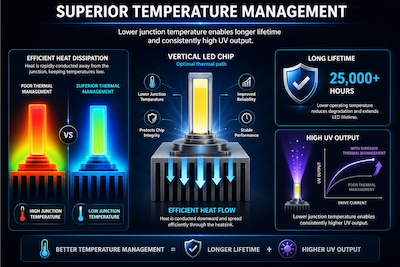
Ensystex has announced an exclusive partnership with LG Lekin to further develop its LED diodes for fly control. LG is a globally recognised leader in electronics, and the LG Lekin super-conductor division is at the forefront of LED diode technology. Of its portfolio of more than 1200 LED patents, many focus on heat dissipation – a critical factor influencing the performance and service life of LED lamps.
The partnership has seen the launch of the new Astron 9 W LED 15R-HF lamp, the world’s first LED replacement lamp that can be retrofitted into existing fluorescent UVA fly control units. The Astron 15R-HF converts any fluorescent unit that uses 15 W lamps into a high-efficiency, energy-saving LED model without rewiring. Installation is as simple as a routine lamp replacement. The lamp also rotates through 360°, ensuring correct orientation in all models.
The new Astron LED lamps utilise the latest LG technology to overcome some of the shortcomings of traditional LED lamps – UVA output and light distribution.
“Most LED diodes convert less than 80% of the electrical energy input into light, with the remainder dissipated as heat. Of the light produced, only a small proportion is emitted in the UVA spectrum,” said Ensystex regional director Steve Broadbent. LED fly control lamps are often considered less effective than traditional fluorescent lamps. A key reason for this is that most LED lamps do not produce sufficient UVA radiant output. For example, a high-performance 15 W fluorescent lamp produces 3-4 W of UVA radiant output, a level that most LED UVA lamps have historically failed to achieve.
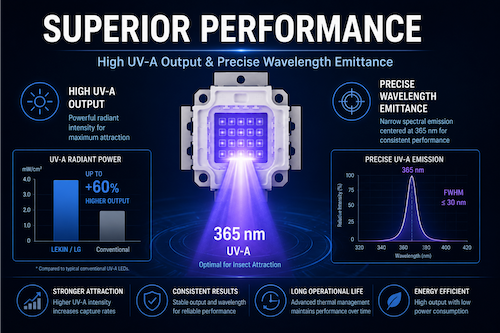
“When selecting lamps for fly control, total electrical power input is irrelevant; the critical parameter is UVA light output,” he explained. “The LED diodes used in Ensystex’s Astron LED lamps convert more than 98% of the electrical energy input into light, with the 9 W 15R-HF lamp producing 5 W of UVA radiant output. This represents a 60% improvement over most LED fly control lamps currently available.”
Mr Broadbent noted that light distribution is another important factor in the performance of fly units. Fluorescent lamps emit light uniformly over the entire surface of the tube, whereas LEDs are inherently point sources. Consequently, a conventional LED lamp typically appears as a series of individual points of light. Ensystex Astron lamps incorporate an exclusive German-developed diffuser that distributes light uniformly across the entire lamp surface, closely replicating the emission profile of a fluorescent lamp. A proprietary pulse algorithm generates a regulated flicker that is detectable by flies but imperceptible to humans, further enhancing attraction. These technologies are combined with precision-engineered Japanese lenses that maximise optical efficiency, leading to high levels of fly attraction.
Ensystex has its own laboratory dedicated to checking and comparing the performance of its Astron lamps to benchmark against other lamps and further enhance lamp performance. This is supported by a similar facility operated by LG Lekin focused on the LED diode performance.
Astron LED lamps have a service life of three years, compared with one year for fluorescent lamps, reducing maintenance requirements and the volume of lamps sent to landfill. The next generation of Astron LED lamps, currently in development, is expected to extend this service life to four years.
“LED technology represents the future of fly control lighting, and Ensystex is committed to advancing its development to deliver lower energy consumption, reduced operating costs, and longer lamp life,” concluded Mr Broadbent.