Sophie Thorogood, Technical Training Manager at Pelsis, offers advice on managing one of the most challenging stored product pests.
The Indian meal moth, Plodia interpunctella, is a prominent pest globally. It targets stored products such as flour, nuts, cereals, and dried fruit and affects many food supply chains. This pest moth is a major contributor to Australia’s stored product pest problem, a complex issue that causes millions of dollars in annual losses through commodity damage, contamination, and market rejection, particularly in stored grain and processed food systems. Present in major cities including Brisbane, Sydney, Melbourne, Adelaide, and Perth, this small moth can cause significant economic damage.
The Indian meal moth (Figure 1, pictured above) has a distinctive red-brown band across the lower portion of its grey wings. The moths will lose this pattern as they age due to the scales rubbing off. The adult moth is 7-9 mm long and, while it is found in food and food manufacturing sites, the adult does not eat the food directly. This is because the adult has atrophied mouthparts, consequently it can’t eat or drink; instead the larvae are responsible for food damage, spoilage and contamination of the product.
The larvae are creamy white (although they have been known to be sometimes be pinker in colour) and have a brown head. A mature larva reaches 12 mm long and will often be found wrapped in silk or webbing that it produces. This silk can become dense and clog machinery when it turns into frass, which is when the webbing contains trapped particles of food and the insects’ faeces.
The presence of adult moths is the most obvious sign that a premises has an Indian meal moth problem. Using monitors correctly will help identify infestations early and highlight the areas of highest activity. Food manufacturing environments can be very dusty, therefore in these locations monitoring traps fitted with lids are effective at protecting the glueboard from dust accumulation.
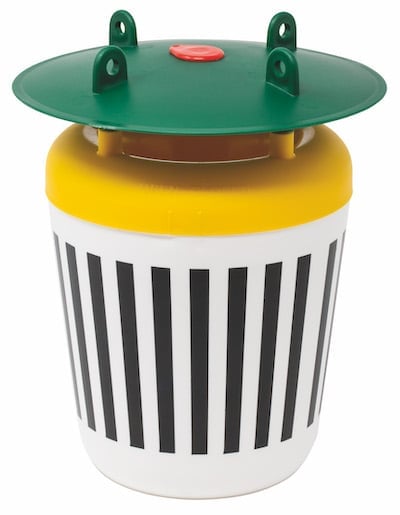
Traps such as the Agrisense Trappit moth pot (Figure 2) are omni-directional, allowing moths to be captured from every side. The pheromone used in this trap is commonly known as ZETA ((Z,E)-9,12-tetradecadienyl acetate) and can be used against a number of pyralid moth species such as Indian meal moth as well as others such as Mediterranean flour moth (Ephestia kuehniella), Almond moth (Ephestia cautella) and Tobacco moth (Ephestia elutella). This pheromone is produced by female moths from their ovipositor and can be turned into a powerful lure to attract male moths into traps.
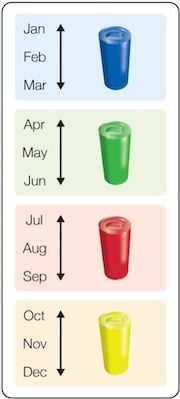
The pheromone must disperse through the air to be detected by male moths; however, it is highly volatile. As a result, pheromone traps should not be placed near high air currents, as this can interfere with the moths’ ability to orient towards the lure. After 12 weeks, the lure must be replaced. The colour coding of lures in the Trappit range helps ensure that effective monitoring is always maintained (Figure 3).
When an infestation has been identified, a multitude of tools can be deployed and used in conjunction to target the life cycle at critical points. For example, the ZETA pheromone can also be used in mating disruption pest management programs to suppress populations. This technique works effectively as part of an integrated pest management approach, alongside the removal of food sources and targeted insecticide application. Insecticide should only be placed in areas where there is no risk of food exposure – the label should be checked to ensure the product is approved. Insecticide treatment should be used in rotation with a cleaning schedule to remove food debris and to apply insecticide in breeding hotspots. Without client cooperation the use of just insecticide will never solve the problem.
In mating disruption, the pheromone is released throughout the environment, saturating the area and making it difficult for male moths to locate female moths. Most insects rely on odour for communication, and by mimicking and dispersing this odour widely, false signals are created. As a result, males fail to locate females, mating does not occur, and subsequent generations are reduced.
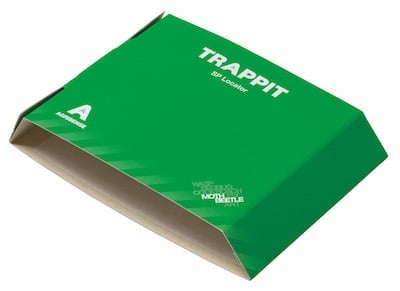
Another monitoring option is the Trappit SPM locator (Figure 4), which can be placed inside machinery or above false ceilings. This is particularly effective, as moths are often present where food has accumulated, and the device can be installed in these areas without disrupting production. Additionally, the pheromone lure is impregnated into the glue, resulting in fewer materials being required and easier disposal at the end of use.
Moth pheromones can be used in multiple ways to manage infestations of P. interpunctella, from being placed into monitoring pots or impregnated straight into the glue to allow effective monitoring to happen in any site or piece of machinery.
Additionally, the use of pheromones in population suppression techniques helps sites better manage moth infestations in combination with other techniques such as cleaning and heat treatment, thereby minimising the need for insecticides.
Sophie Thorogood, Technical Training Manager, Pelsis