
A guide to understanding the benefits and limitations of the popular ‘spider spray’.
Spider treatments can be very effective. Indeed, it is not uncommon to see service free periods on spider treatments from three months to a year! However, sometimes these warranties are restricted to web-building spiders, with concern regarding the performance of surface treatments on running or hunting spiders. Is this a valid concern and how do spider treatments actually work?
Firstly, let’s look at how insecticides work with spiders. If spiders get hit directly with the insecticide spray, they will die quickly. The speed to kill will depend on the insecticide used, but typically with a bifenthrin spray, spiders will die within minutes of being sprayed, which helps to impress customers! Bifenthrin is a highly effective spider pesticide, with spiders being significantly more sensitive to bifenthrin than fipronil (LC50 on redback spider: 0.575 v 13.179).1
Insecticides work quickly via direct spraying because the spiders receive a high dose and it is absorbed quickly through their cuticle. However, speed of control is far slower when the insecticide is picked up when walking across a dry, treated surface.
Any insecticide that gets picked up on their body enters the body through absorption through their cuticle or through ingestion. Web-building spiders will ingest web material for recycling so can ingest insecticide from treated webs. All spiders can ingest insecticide picked up on their legs as they regularly groom the tarsi on their legs to maintain the performance of their chemoreceptors (for chemical detection) and mechanoreceptors (for vibratory signals).
It is interesting to note that spiders also appear to avoid freshly applied insecticide treatments, although this repellency drops off after 24 hours, with spiders then readily walking on most treated surfaces.2 This even applies to pyrethroids, so after the first day or so, the surface spray is not working as a repellent but as a treated zone, which requires the spider to walk on it to pick up insecticide. The speed of performance depends on how much is picked up (which depends on the concentration on the surface, the time spent on the surface and the amount of body contact with the surface) and the size of the spider.
In terms of amount of body contact with a surface, there is a significant difference between running spiders and web-building spiders.
When hunting spiders (e.g. huntsman, white-tailed spiders and wolf spiders) move, they walk on the tips of their legs. Spiders use hydraulics to move their legs; while they have muscles to flex their legs inwards, they use hydraulic pressure (haemolymph forced from the cephalothorax into the legs) to extend them outwards. In doing so it lifts their body off the ground, and they walk on the tips of their legs.
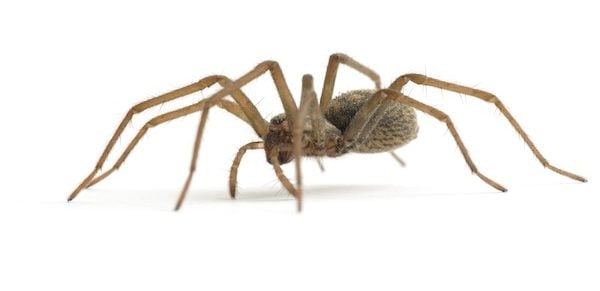
of insecticide
If the spider’s abdomen is being dragged along the ground, the spider is either unwell or may be a gravid female. Net, spiders walking across a treated surface will generally pick up insecticide on the tips of their legs.
The question is whether they pick up enough insecticide to actually kill them. In laboratory trials when spiders are often confined to a treated surface for 24-48 hours, mortality is generally 100%. But in the field when the time spent on a treated surface can often be measured in minutes or even seconds, the amount of insecticide picked up will often be sub-lethal. Even if a lethal amount is picked up, it will often take hours to die, which means the spider can still cross a treated zone and enter a building.
The effect of sub-lethal doses on spiders appears to be different to insects. While insects show hyperactivity, spiders slow down and show clumsy and staggered movements, before ceasing movement altogether.3 At lower sub-lethal doses, the spider maintains a normal position, whereas at higher sub-lethal doses the spider will demonstrate a paralysis position (legs curled up). The differences in effect on spiders versus insects can largely be explained by the unique muscles/hydraulic system used to drive movement in the spider’s legs. Spiders can start recovering from these sub-lethal doses after 48 hours, if not eaten by a predator first!
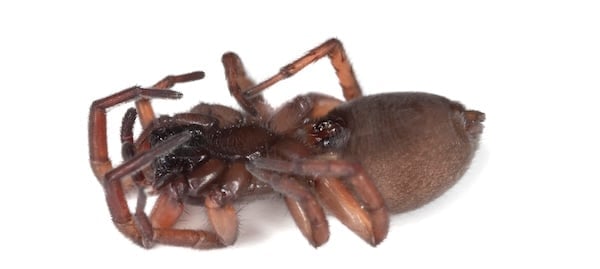
legs, which is why their legs curl up when they die
Web-building spiders will also tend to walk on the tips of their legs, but by their nature they tend to hide in cracks and crevices, if they are not in their webs. If a comprehensive spider spray has been carried out, these cracks and crevices will be treated with insecticide and the spider will pick up insecticide on all parts of its body (not just the ends of its legs) when squeezing into the space, therefore picking up a significant dose of insecticide. Apart from hitting web-building spiders directly during application, the residual impact on web-building spiders is also likely to deliver higher levels of mortality than with running spiders.
In terms of sub-lethal effects on web-building spiders, they too become sluggish, but they also exhibit problems with web-building, producing small webs with construction faults, or not building their webs at all.4
Temperature also has an impact on insecticide performance. On receiving a lethal dose, mortality occurs faster in warmer temperatures due to increased absorption. However, if spiders pick up a sub-lethal dose, they recover quicker in warmer temperatures, due to the increased speed of metabolic breakdown of the insecticide.
Dealing with spider webs is also a consideration when carrying out a spider treatment. It is definitely a good idea to tell the customer not to touch any webs prior to your visit, as it clearly helps identify spider locations. Most pest managers will spray the webs as part of the treatment and instruct customers to leave them in place for a couple of days before brushing them down. The thinking being that any hidden spiders not contacting the initial spray will pick up a lethal dose when they emerge onto their web. An alternative method worth considering is to brush the web down before application. Any spider present is likely to show itself, and if not, the hiding place for direct application should be obvious. The benefit here is that the house minus the webs will look visually appealing at the end of the treatment, and the absence of webs acts as further evidence that a treatment has been carried out and is working.
Any spider that does emerge from an untreated area would still pick up a lethal dose off the surface when trying to rebuild its web.
So, what does this all mean for spider treatments?
Pyrethroids, especially bifenthrin, should be considered the best option for spider treatments. In carrying out a spider treatment, make every effort to locate and treat spiders directly, as this will deliver the best performance. If a comprehensive application is carried out to spider hiding places and likely web-building sites, it will deliver longer residual performance on web-building spiders. Residual performance on running spiders is likely to be limited and so any blanket service free period for spider treatments (without restricting it to web-building spiders) needs to be carefully considered.
The one thing to bear in mind regarding hunting spiders is that they feed on insects and web-building spiders. As a comprehensive spider treatment or general pest spray will eliminate much of the prey for hunting spiders, it will make the location less attractive to these spiders, and they are likely to search elsewhere for a meal. The end result is that the number of hunting spiders around the building perimeter will likely be reduced without having to kill the spiders directly.
1 Hayasaka, D et al. (2021). Differences in Bifenthrin and Fipronil Susceptibility. Among Invasive Latrodectus spp. (Araneae: Theridiidae) and Nontarget Spiders in Japan. Journal of Economic Entomology, 114(1), 2021, 257–264. doi: 10.1093/jee/toaa293
2 Pekar, S. and Haddad, C.R. (2005). Can agrobiont spiders (Araneae) avoid a surface with pesticide residues. Pest Manag Sci 61:1179–1185 (2005). DOI: 10.1002/ps.1110
3 Baatrup, E, and Bayley, M. (1993). Effects of the Pyrethroid Insecticide Cypermethrin on the Locomotor Activity of the Wolf Spider, Pardosa amentata: Quantitative Analysis Employing Computer-Automated Video Tracking. Ecotoxicology and Environmental Safety, 26: 138-162.
4 Rhoades, S.N. and Stoddard, P.K. (2021). Nonlethal Effects of Pesticides on Web-Building Spiders Might Account for Rapid Mosquito Population Rebound after Spray Application. Appl. Sci. 2021, 11(4), 1360. doi. org/10.3390/app11041360