Thermal fogging is an excellent value-add services for pest managers to offer customers, especially those working primarily with commercial clients.
For decades, thermal fogging has quietly occupied a unique place within professional pest management. While many technicians are familiar with the equipment, relatively few businesses have embraced it as a core service offering. Those who have, however, often discover something their competitors miss: thermal fogging isn’t simply another application method, it can become a genuine point of difference that opens doors to new markets and premium service opportunities.
As customers increasingly seek faster treatments, minimal disruption and improved access to difficult-to-reach harbourage areas, thermal fogging is experiencing renewed interest. Warehouses, food manufacturing facilities, commercial buildings, roof voids, grain storage facilities, shipping containers, large industrial premises and intensive livestock operations all present environments where space treatments can provide advantages that conventional spraying simply cannot.
David Priddy, managing director of Sundew Solutions, believes thermal fogging has always been one of the industry’s most under-utilised tools. “One of the things we’ve noticed over the past decade is that thermal fogging has become a service that is rarely offered by professional pest managers,” he explains. “Those operators who understand where it fits can deliver outstanding results while creating a valuable point of difference for their business.”
Unlike conventional surface spraying, thermal fogging is designed to fill a space. The dense fog behaves almost like a gas, remaining suspended long enough to penetrate cracks, ceiling voids, machinery, cable trays, storage racking and other inaccessible areas where flying and exposed crawling insects may be harbouring. It is not intended to replace residual treatments, but rather to complement them by delivering rapid knockdown across entire treatment zones before residual chemistry delivers long-term control.
The commercial opportunity extends well beyond insect control. Many businesses already schedule annual shutdowns, maintenance periods or after-hours cleaning programs where thermal fogging can be incorporated as part of a broader pest management service. Food manufacturing plants, commercial kitchens, warehouses, logistics centres, hospitality venues and processing facilities all benefit from rapid space treatments that minimise downtime and ensure a continued high level of service.
“Customers often perceive thermal fogging as a premium service because it looks different and solves problems that traditional spraying sometimes cannot,” says Mr Priddy. “It allows pest managers to offer something genuinely specialised while adding value to their existing service programs.”
Of course, equipment alone does not guarantee professional results. Successful thermal fogging begins with good preparation. Treatment areas should be appropriately sealed where practical to maximise fog retention, air movement should be minimised during application, and operators should allow sufficient contact time before ventilation. Understanding airflow, application timing and equipment calibration are all critical factors in achieving consistent results. Like any professional application technique, thermal fogging requires good practice and attention to detail.
Recognising renewed interest in this method, Sundew recently introduced TyphoonDuo Pro Concentrate together with Sundew ProFog, representing a completely new approach to professional space treatments. Rather than developing another conventional pyrethrum concentrate, Sundew set out to modernise the entire category.
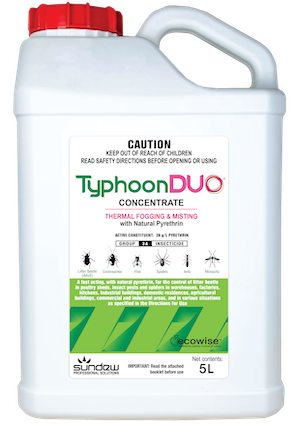
TyphoonDuo combines high-strength natural pyrethrins at 28 g/L with advanced water-based microemulsion technology, creating one of the highest strength professional pyrethrin concentrates available to Australian pest managers. The higher concentration means operators carry significantly less product while maintaining the same active ingredient loading, reducing vehicle storage requirements, packaging and transport weight.

Perhaps more importantly, TyphoonDuo has been developed as a genuine multi-application concentrate. The same bottle can be used for thermal fogging with Sundew ProFog, ULV cold misting with water, or conventional direct spray applications.
“We wanted to simplify the way operators work; rather than carrying separate products for different application methods, we wanted one professional concentrate capable of thermal fogging, ULV cold misting or direct spraying depending on the job. That flexibility makes life easier for technicians while reducing inventory and vehicle storage,” added Mr Priddy.
Behind the versatility sits a modern formulation philosophy. TyphoonDuo is manufactured using advanced water-based microemulsion technology rather than relying on traditional solvent-heavy systems. Approximately 94% of the formulation consists of non-hazardous ingredients, while the product is non-flammable and formulated without piperonyl butoxide (PBO).
Although PBO has historically been included in some pyrethrum formulations as a synergist, Sundew deliberately developed TyphoonDuo without it.
“There is increasing interest from both pest managers and their customers in understanding exactly what is being applied,” says Mr Priddy. “Being able to offer a modern, PBO-free formulation with lower solvent loading provides a cleaner story while still delivering the rapid knockdown professionals expect from natural pyrethrins.”
Complementing TyphoonDuo is Sundew ProFog, a specialised thermal fogging carrier developed to enable modern water-based formulations, such as the TyphoonDuo microemulsion (ME), to be effectively applied through thermal fogging equipment.
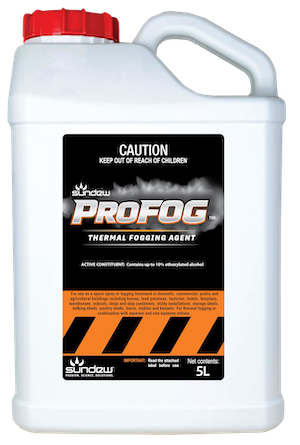
“One of the biggest technical challenges with thermal fogging has always been compatibility between water-based formulations and traditional fogging carriers,” Mr Priddy said. “ProFog was specifically developed to solve that issue while producing a dense, fine fog with excellent hang time and penetration.”
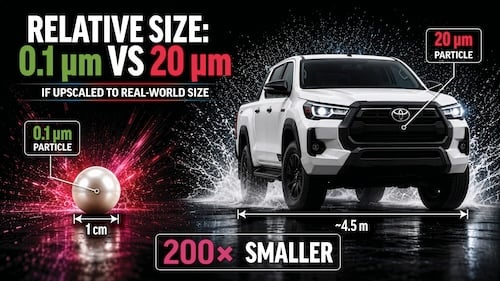
Traditional thermal fogging carriers were largely developed around older solvent-based chemistries, whereas ProFog bridges the gap between conventional thermal fogging technology and today’s increasingly sophisticated formulation systems. Its advanced surfactant technology provides compatibility across a broad range of formulation types, including emulsifiable concentrates (EC), emulsions in water (EW), microemulsions (ME), soluble liquids (SL) and dispersion concentrates (DC).
Beyond insecticides, ProFog is also compatible with many water-based disinfectants and sanitisers, including formulations containing glutaraldehyde, peracetic acid and formaldehyde, where permitted by the relevant product label.
“The opportunity here goes well beyond a single insecticide,” he added. “It gives operators greater flexibility to use thermal fogging with a much broader range of modern formulations and across applications where effective space treatment and deep penetration are required.”
This versatility extends the potential of thermal fogging across commercial and industrial pest management, food processing, agriculture and livestock facilities, vector-control programs, grain silos and stored-product facilities, warehouses, shipping holds and containers, and hygiene and sanitation applications.
As the pest management industry continues to evolve, clients increasingly value professionalism, efficiency and innovation. Thermal fogging is no longer simply a niche service reserved for specialist operators. With modern formulations, improved equipment and a growing appreciation of where space treatments fit within integrated pest management, it represents a genuine opportunity for progressive businesses to expand their service offering.
“I believe thermal fogging is entering a second generation,” Mr Priddy concludes. “Better chemistry, better carrier technology and better application methods are changing perceptions of what professional space treatments can achieve. For pest managers prepared to embrace it, thermal fogging offers an opportunity not only to improve treatment outcomes but also to build a more differentiated and profitable business.”