Lindsay McRae, Regional Manager (NSW & ACT) at FMC, outlines control options for two ant species that are particularly challenging in commercial accounts.
Ants are a significant pest in commercial accounts. Pest ants often nest in and around buildings, and can congregate in food preparation areas. Although they are not known to spread disease in the same way as cockroaches and houseflies, in theory they still have the potential to spread microbes and are certainly a concern in the healthcare environment in that regard. Irrespective, in food management establishments they represent a clear contamination issue.
Ant management can often require dealing with ants nesting inside the building, but often it is aimed at excluding ants from the building and reducing the ant pressure in the surrounding area. This is particularly the case with invasive ant species which can dominate local areas, outcompeting native ant species. Their large populations result in regular invasions of nearby buildings.
Here we are look two nuisance ants – one that nests inside buildings (pharaoh ant), and one that typically nests outside buildings (big-headed ant).
Pharaoh ant (Monomorium pharaonis)
Originally from West Africa, the pharaoh ant (pictured above) was first discovered in Australia in the 1850s and has now been introduced to virtually every area of the world. Notorious for infesting hospitals and aged care facilities, where it is considered a health risk, it is known to be one of the hardest ant species to manage.
The pharaoh ant is small in size at 1.5-2.4 mm long and is golden yellow to red in colour, with black markings on the top of the abdomen. It has no bite, sting or odour when crushed.
With large colonies, often containing many queens (polygynous), they nest in household/building structures in any available cavity, and disperse by budding, often spreading throughout large buildings.
Pharaoh ants prefer high protein foods such as meat but have a generalist diet.
Big-headed ant (Pheidole megacephala)
The big-headed ant, or coastal brown ant, is one of the most widespread invasive ant species in the world and has been established in Australia for over 100 years. Big-headed ants easily out-compete and displace local ant species due to their highly aggressive behaviour.
Colonies have two sizes of workers: minor workers 1.5-2.5 mm in length and major workers 3.5-4.5 mm in length. They are named for their major workers, which have disproportionately large heads in comparison with their bodies. Big-headed ants vary in colour from light to dark brown, and are sometimes reddish brown. Like the pharaoh ant, they have no sting, but will occasionally deliver a mild bite.
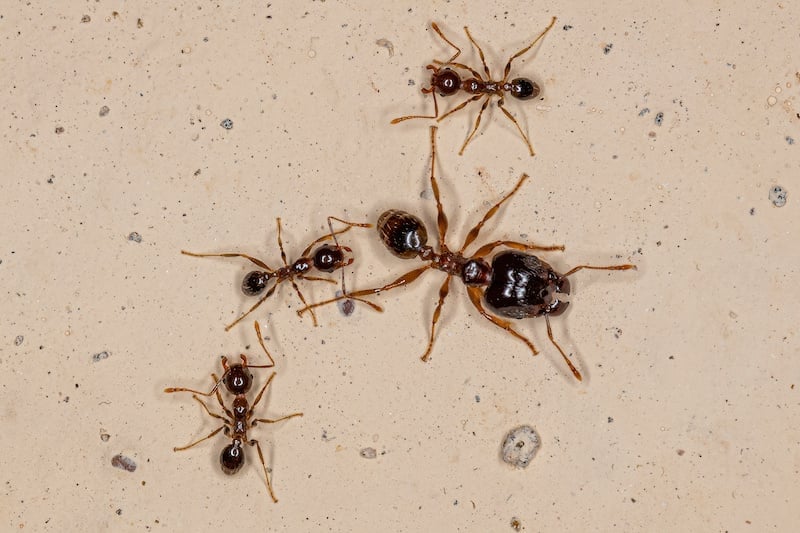
The big-headed ant excavates extensively under concrete and paving slabs, causing destabilisation. They can invade buildings when populations are very high, especially in commercial properties where food scraps are easily found.
They tend to nest in disturbed soils, under pavers, pot plants and other objects. Like the pharaoh ant, bigheaded ant nests comprise multiple queens, making them capable of budding and forming interconnected super-colonies that cover tens of hectares.
Big-headed ants prefer fats and proteins but will occasionally eat sweet food.
Suggested treatment plan
The treatment for both of these invasive ants requires a coordinated, multi-pronged approach. Firstly, foraging trails should be baited. Secondly, any identified nests should be treated by direct nest application with liquid and/or granules. Thirdly, to prevent ingress, a liquid insecticide should be applied to the building perimeter. Internal crack and crevice harbourages should then be treated with aerosol/dust and bait. Lastly, hygiene and exclusion measures must be taken and the customer educated on the importance of continuing these practices.
All products in the FMC general pest range carry an ant registration. Notably Biflex Mikron and Astro also have HACCP approval while along with Biflex Ultra, Biflex Aqua and Fury are registered for internal use. Externally, Brigade Granular is a popular option around perimeters, paved and lawn areas while Dragnet Dust offers an excellent option for roof voids and wall cavities.
It is important in every situation that an IPM (integrated pest management) program is adopted, within which an FMC product(s) can always be incorporated.
Lindsay McRae, Regional Manager – NSW & ACT, FMC