The discovery of more queen hornets continues to give Aucklanders cause for concern.
Biosecurity New Zealand is continuing its efforts to locate and eliminate nests of the yellow-legged hornet (Vespa velutina), which have been detected at multiple locations on the North Shore of Auckland. A smaller relative of the giant Asian hornet (the “murder hornet”), which has also made invasive incursions in a number of countries, it also represents a significant ecological and safety concern.
Since the first sighting on October 17, 24 queen hornets, two workers and 14 nests have been successfully located and removed from sites in Glenfield and Birkdale.
The response is supported by a technical advisory group formed of independent scientific experts from countries that have successfully managed hornet incursions. Biosecurity New Zealand staff have been hanging traps within a 5 km radius of the detection zone, which use a combination of carbohydrate and protein lures. Advanced tracking technology from the Netherlands is also being used to trace hornets back to their nests.
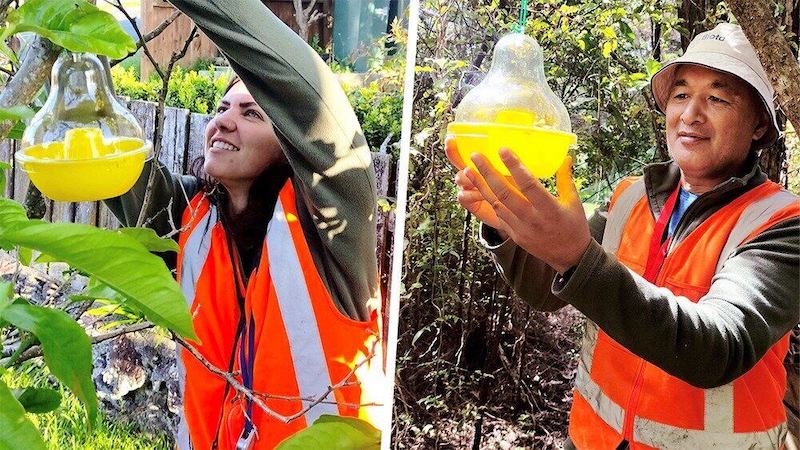
been detected (photo credit: Ministry for Primary Industries/CC 4.0)
However, Aucklanders have been critical of the Ministry for Primary Industries’ seemingly slow response to the crisis, with many homeowners pressuring the government for information about how to make DIY hornet traps to bolster trapping efforts.
The outbreak is of significant concern because the hornets are carnivorous, with honey bees comprising around 40% of the hornets’ diet. The remainder is flies, wasps and other pollinators.
Writing for The Conversation, Phil Lester, Professor of Ecology and Entomology at the University of Wellington, explained how hornets prey on bees. “When preying on honey bees, hornets hover outside hive entrances, waiting for tired bees to return from their foraging trips. The hornet snatches the bee mid-flight, kills it, and carries its body back to its nest as food. If bees sense the hornets, they may stop foraging altogether, staying inside the hive – a behaviour known as ‘foraging paralysis’.”
With honeybees their primary target, the hornets pose a threat to New Zealand’s $400 million annual honey export business. But greater than that, they will threaten the 27 native bee species and countless other insect pollinators that industries such as kiwi fruit and avocado rely on.
It is hoped that New Zealand avoids the fate of France, where the yellow-legged hornet was accidentally introduced in 2004. It spread rapidly, at around 100 kilometres per year, and was established across the country by 2017. New Zealand’s warm, temperate climate provides the ideal environment for the hornet to thrive – and if it becomes established, it means Australia might be next.